Who to sell to
Your positioning, ideal customer profile, buying committee and the industries to go after first.
Answer a guided intake about your company, buyers and sales motion. The Cashewleads team builds your playbook from those answers: 17 sections, or a shorter 10-section version, delivered after review.
Or get the Playbook + 4 Jade Bots for $799.
$499.00 one-time. Checkout is not open yet. Have a promo code? Enter it on the last step of the intake.
Every section is built only from what you tell us. Anything we can't know from your answers is marked [Needs input], never guessed.
Your positioning, ideal customer profile, buying committee and the industries to go after first.
Stages with entry and exit criteria, a qualification scorecard and a discovery guide for your buyers.
Outbound messaging and cadence, demo and pilot plans, the business case, pricing and objection handling.
A proof-point plan, enablement, metrics and a 30/60/90 rollout, plus every gap flagged in one checklist.
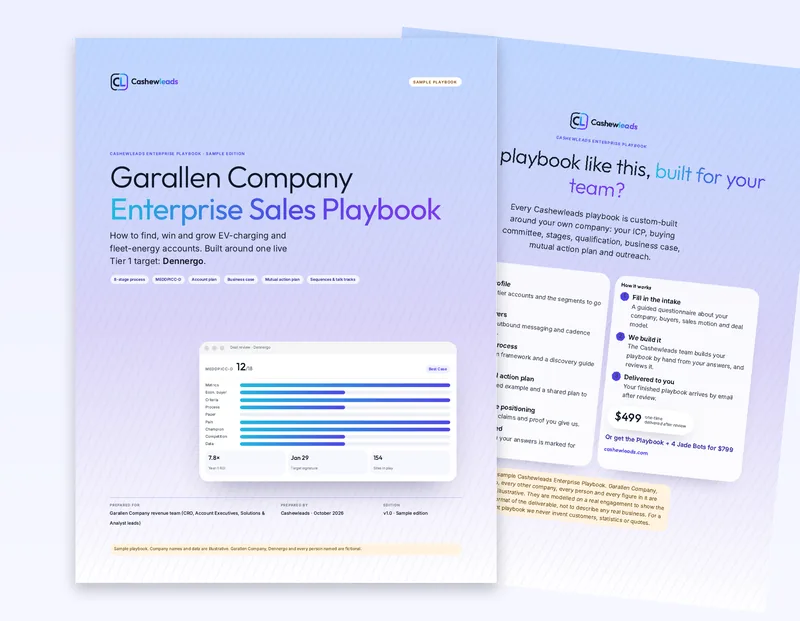
A 47-page Enterprise Playbook written for Garallen Company, a fictional company, worked through one target account, Dennergo.
Sample playbook. Company names and data are illustrative. This is a sample Cashewleads Enterprise Playbook. Garallen Company, Dennergo, every other company, every person and every figure in it are fictional and illustrative. They are modelled on a real engagement to show the depth and format of the deliverable, not to describe any real business.
Pick a section to preview it. Every table, figure and talk track is filled in for the fictional example account.
Part I · Section 01
What Garallen Company sells, to whom, and how
Ground every conversation in facts. This section captures what Garallen Company actually sells, to whom and how, as of Oct 16, 2026, and tags each finding with its source and confidence. Sellers use the right-hand column; leadership validates anything not marked Sourced.
Part II · Section 02
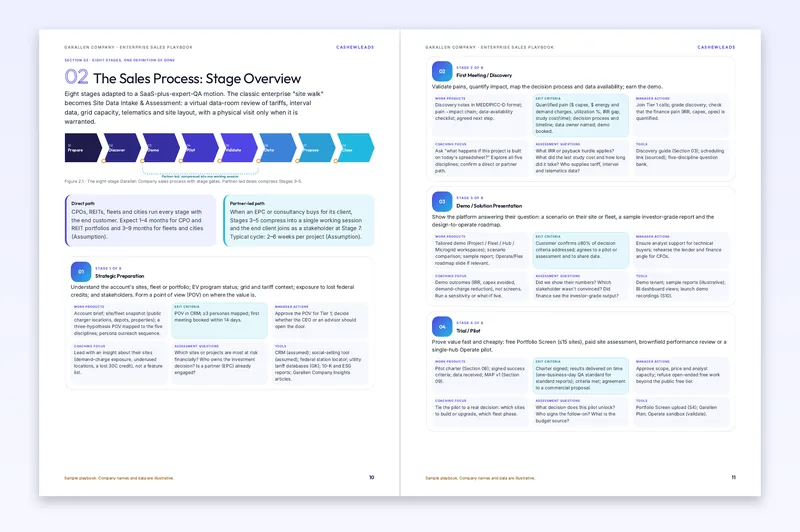
Eight stages, one definition of done
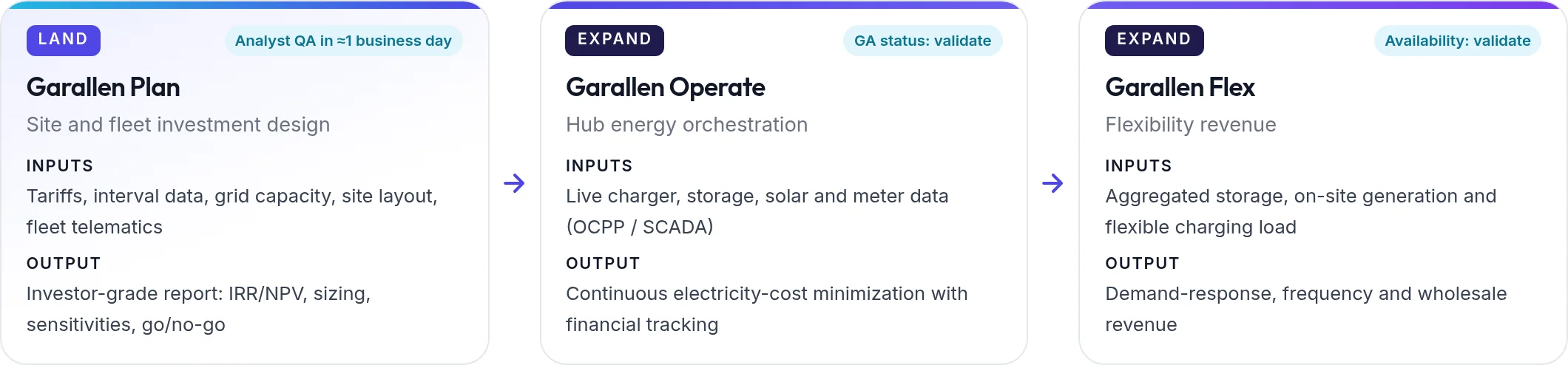
Eight stages adapted to a SaaS-plus-expert-QA motion. The classic enterprise "site walk" becomes Site Data Intake & Assessment: a virtual data-room review of tariffs, interval data, grid capacity, telematics and site layout, with a physical visit only when it is warranted.

Part II · Section 03
Pipeline → qualification → discovery → demo → pilot → partners → executives
This section turns the stages into daily work: where pipeline comes from, how to qualify it, how to run discovery by persona, how to demo and pilot, how to work with partners and executives, and how to spot a stalled deal before the forecast does.
Part III · Section 04
Where to hunt, in what order, with what capacity
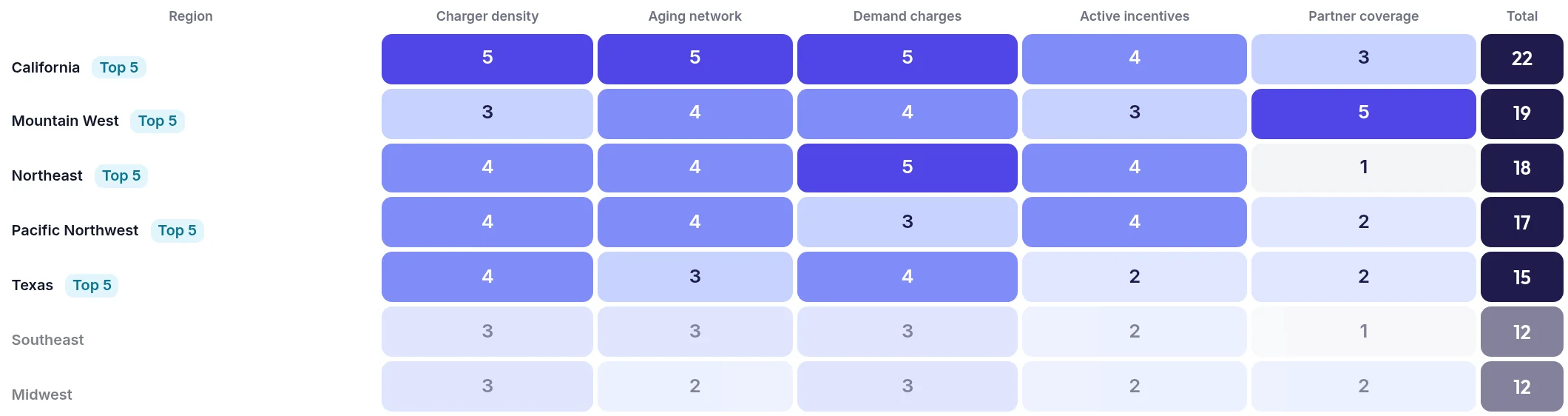
With a small team, territories are best cut by segment and region (for example: Mountain West and California CPO/retail; national REIT/CRE; fleets and logistics; Canada). Targets below are illustrative assumptions. Calibrate them to quota and to capacity, including analyst QA capacity, which is the real constraint on how many pilots can run at once.
Part III · Section 05
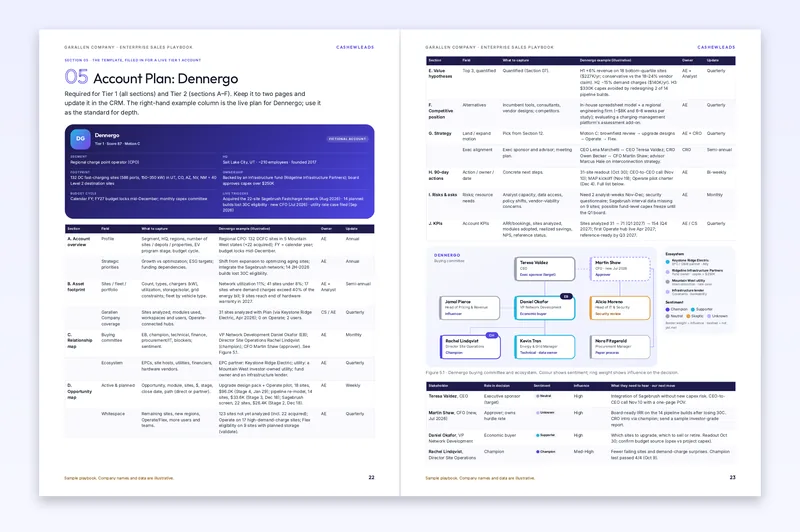
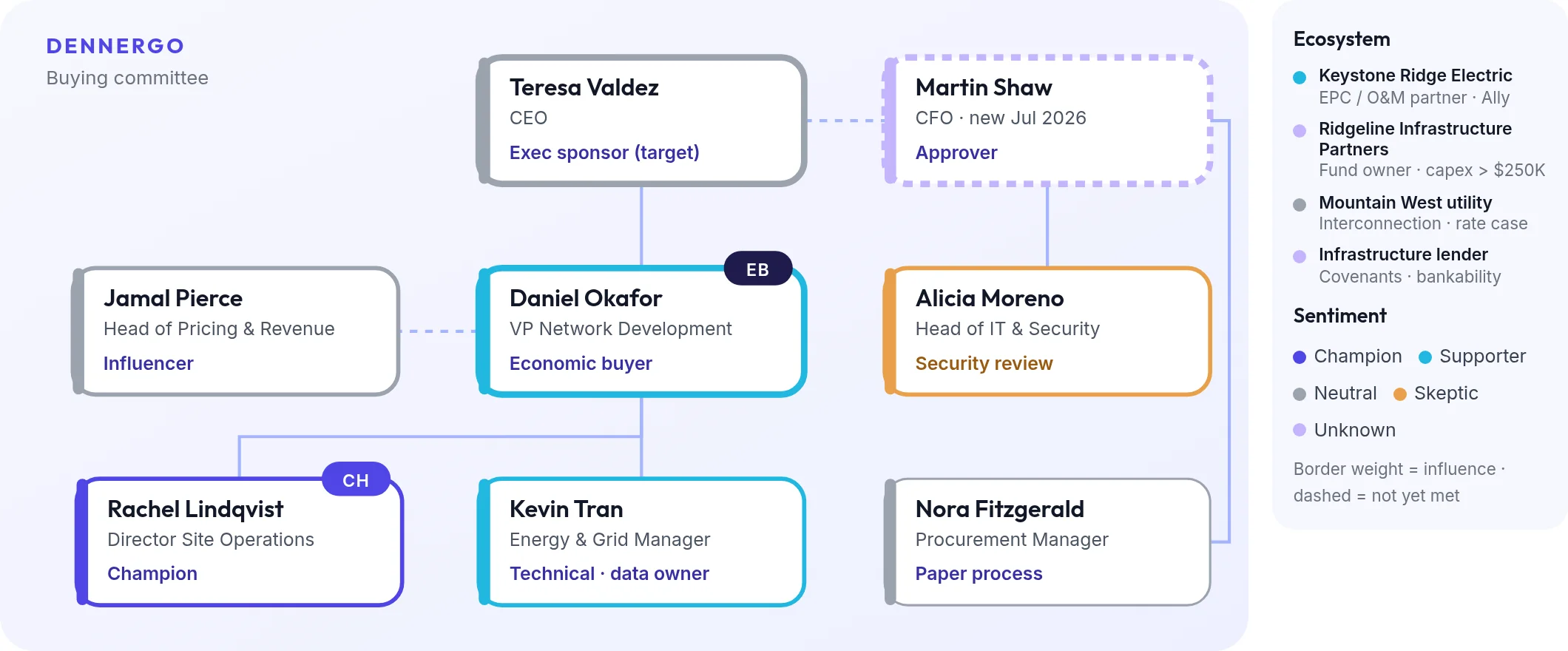
The template, filled in for a live Tier 1 account
Required for Tier 1 (all sections) and Tier 2 (sections A–F). Keep it to two pages and update it in the CRM. The right-hand example column is the live plan for Dennergo; use it as the standard for depth.
Part IV · Section 06
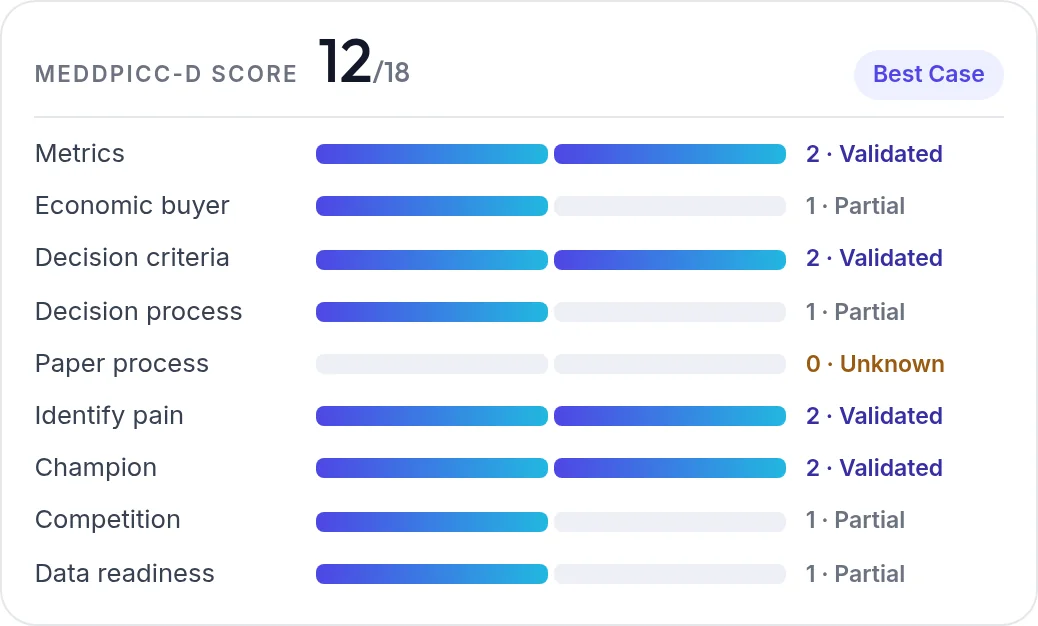
Twenty minutes that decide the forecast
Run a review for every opportunity of $25K or more in first-year value (illustrative threshold), every Tier 1 deal, and before anything moves to Commit. Twenty minutes: the AE presents, the CRO challenges, the analyst lead joins for scope and capacity.

Part IV · Section 07
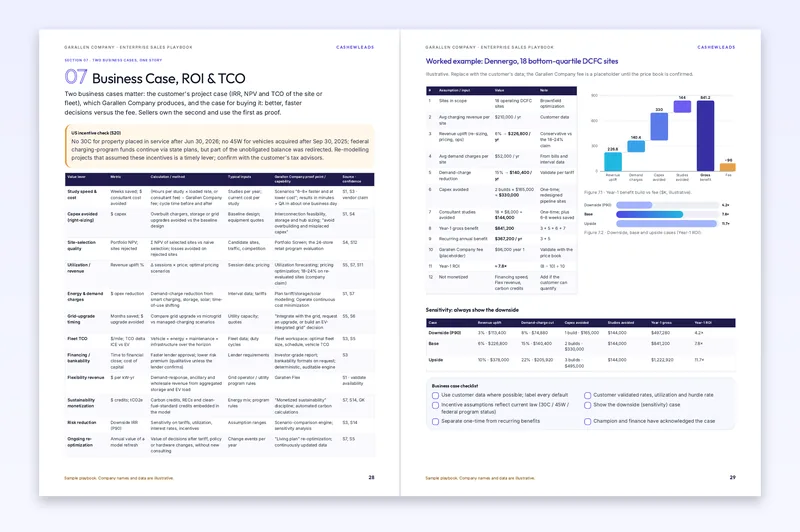
Two business cases, one story
Two business cases matter: the customer's project case (IRR, NPV and TCO of the site or fleet), which Garallen Company produces, and the case for buying it: better, faster decisions versus the fee. Sellers own the second and use the first as proof.
Part IV · Section 08
Prove value fast, cheaply and toward a decision
Default policy: free only within the public Portfolio Screen tier (≤15 sites). Every other pilot is paid, or credited against a follow-on order (policy is an Assumption; validate). Standard deliverable SLA: results QA-reviewed within about one business day of complete data (S3).
| Pilot type | When to use | Scope & duration | Success criteria (examples) | Customer commitments | Garallen Company resources | Exit to commercial |
|---|---|---|---|---|---|---|
| Portfolio Screen (self-serve) | REITs, property owners and multi-site retailers exploring EV, solar or storage | ≤15 addresses; same day to a few days; $45 per additional site | Ranked list with latent-value estimates; ≥3 sites worth deeper design | Upload a spreadsheet; 30-min readout | Automated + AE readout | Paid Plan designs for top sites; portfolio subscription |
| Paid greenfield site assessment | CPO, EPC or retailer deciding where and what to build | 1–5 sites; 1–3 weeks | Investor-grade report per site; go/no-go; IRR/NPV ranges accepted by finance | Site data, tariffs, budget owner at the readout | Analyst QA; AE | Multi-site pack or subscription |
| Brownfield performance review | CPOs with aging or underperforming sites (EPC-partner model) | 10–40 sites; 3–8 weeks | Sites ranked by upside; upgrade designs (chargers, storage, ops); quantified uplift | Utilization and session data, bills, charger inventory | Analyst team; CEO/CRO readout | Upgrade designs + Operate on upgraded sites |
| Fleet transition study | Fleets planning ICE→EV for a depot or region | 1 depot or fleet segment; 2–6 weeks | Optimal fleet mix and schedule; depot charging and grid plan; TCO | Telematics and route data, vehicle list, depot electrical info | Analyst; telematics advisor | Multi-depot rollout; Operate at the depot |
| City / transit planning study | Municipalities needing funding-ready plans | Program level; 4–8 weeks | Emissions baseline and reduction; funding-application-ready financials | Fleet and site data; procurement path | Analyst; utility advisor | Platform access for departments; ongoing reporting |
| EPC partner trial | EPCs and consultants evaluating Garallen Company for bids | 2–3 live bids; 30–60 days | Proposal time down; win rate; client acceptance of the report | Real bids; partner agreement | Partner lead; analyst | Partner subscription or per-project agreement |
| Operate single-hub pilot | A built hub with storage/solar or demand-charge issues | 1 hub; 60–90 days | Electricity cost down vs baseline; uptime; data integration (OCPP / SCADA) | Network / SCADA access; site operator | R&D integration engineer (validate GA status) | Operate subscription across hubs |
| Flex eligibility assessment | Portfolios with storage or flexible load in active markets | Portfolio; 2–4 weeks | Eligible MW; projected $/kW-yr; program pathway | Asset list; interconnection details | Analyst; utility advisor | Flex enrollment (validate availability) |
Part IV · Section 09
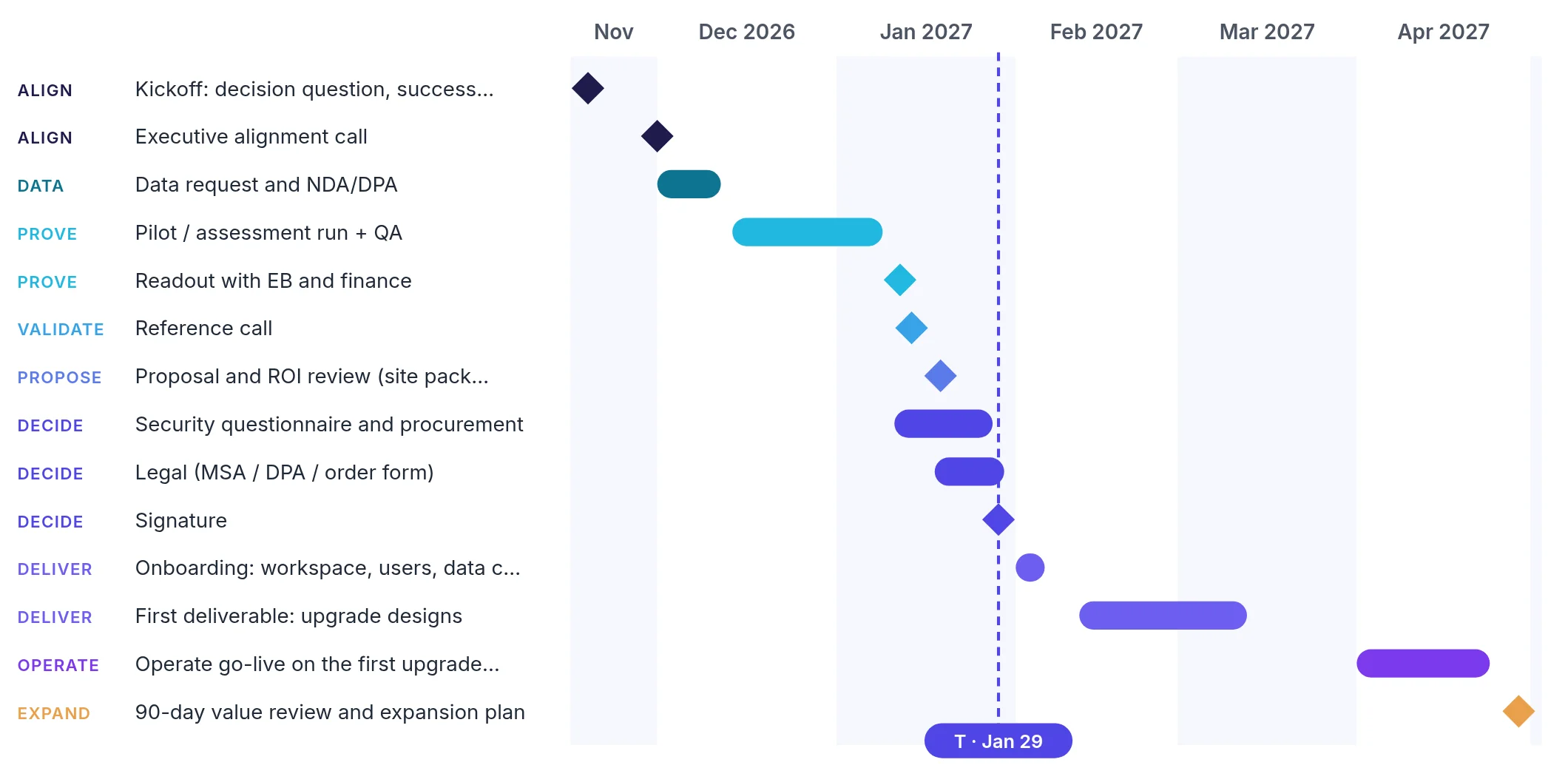
One shared plan from kickoff to the 90-day value review
Shared with the customer, and with the partner where relevant. The example is Dennergo's brownfield review → upgrade designs → Operate path. Dates are relative to target signature (T = Fri Jan 29, 2027), with calendar dates for this account. Partner-led deals add an end-client approval milestone.
Part V · Section 10
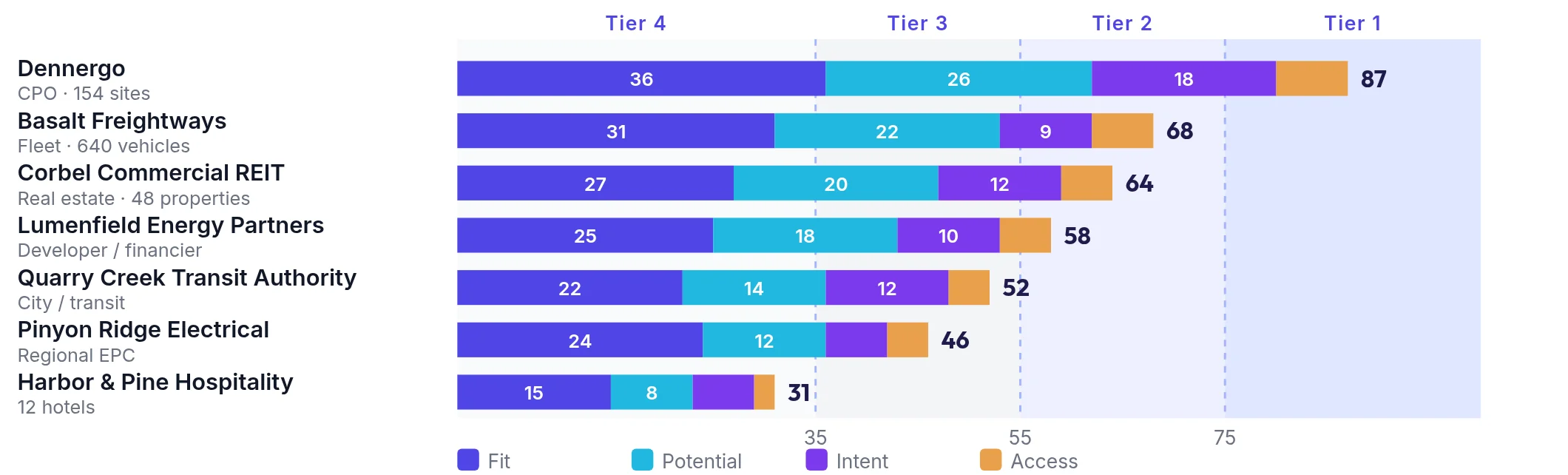
Spend time where the score says, not where the logo says
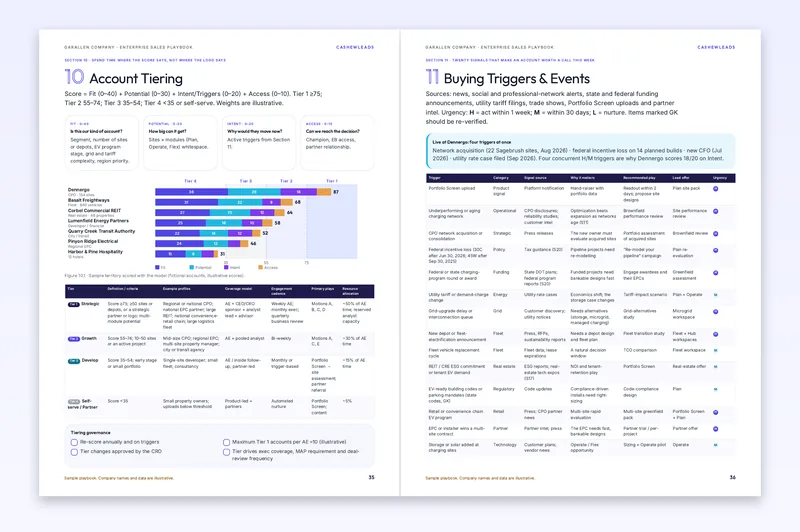
Score = Fit (0–40) + Potential (0–30) + Intent/Triggers (0–20) + Access (0–10). Tier 1 ≥75; Tier 2 55–74; Tier 3 35–54; Tier 4 <35 or self-serve. Weights are illustrative.
Part V · Section 11
Twenty signals that make an account worth a call this week
Sources: news, social and professional-network alerts, state and federal funding announcements, utility tariff filings, trade shows, Portfolio Screen uploads and partner intel. Urgency: H = act within 1 week; M = within 30 days; L = nurture. Items marked GK should be re-verified.
Part V · Section 12
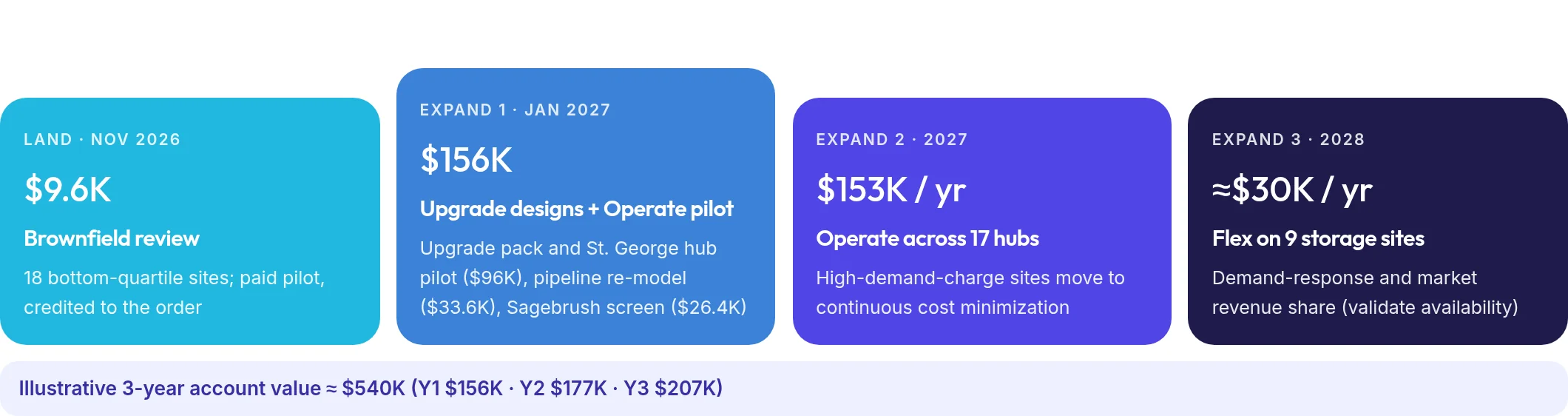
Six motions, each with a land offer and three expand steps
One row per motion. Write the chosen motion, with dates, into the account plan (Section 05).
Part VI · Section 13
What to say, in what order, to whom
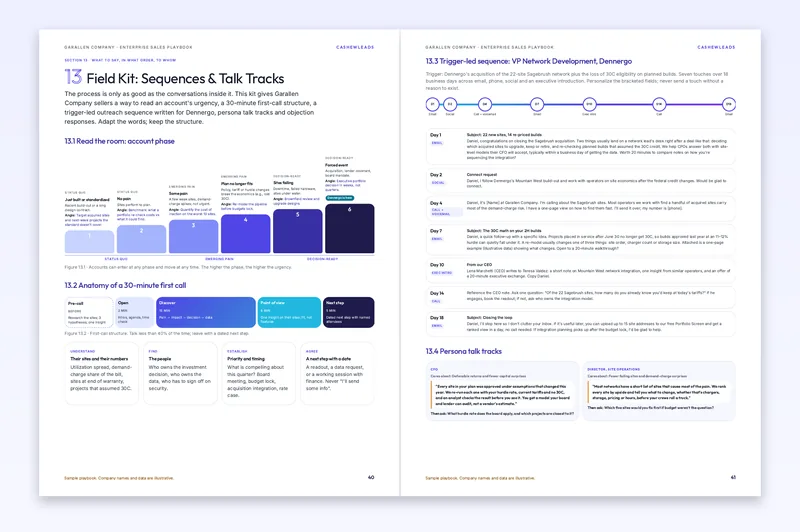
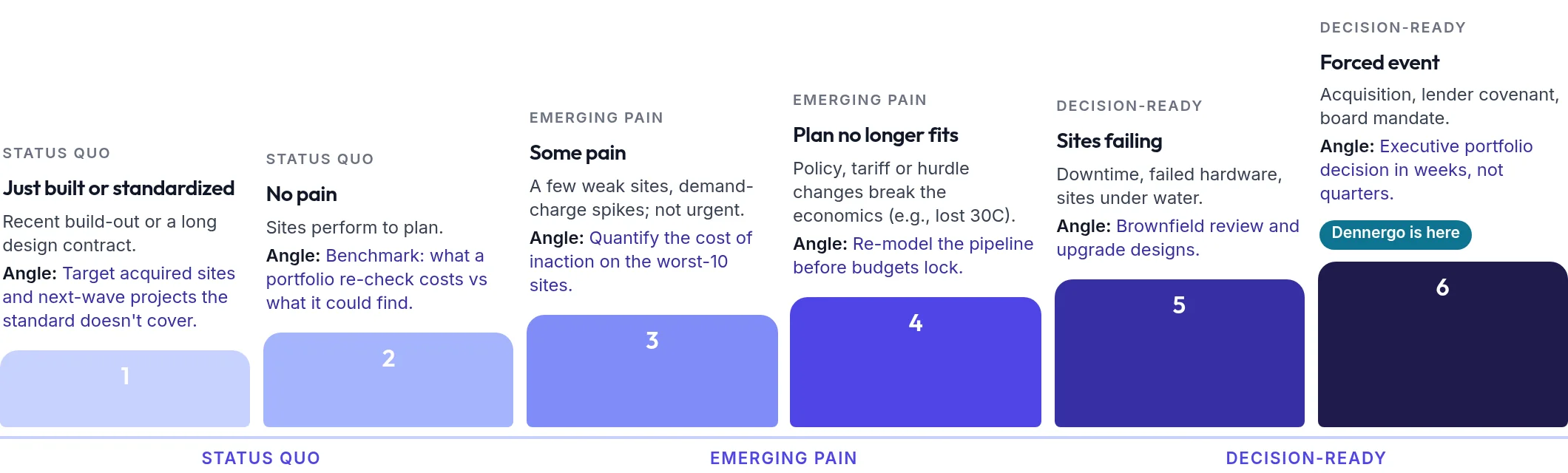
The process is only as good as the conversations inside it. This kit gives Garallen Company sellers a way to read an account's urgency, a 30-minute first-call structure, a trigger-led outreach sequence written for Dennergo, persona talk tracks and objection responses. Adapt the words; keep the structure.
Appendix A
What was adapted, what was assumed, who validates
This playbook adapts a reference enterprise-playbook structure (originally written for a hardware-plus-cloud field-sales motion) to Garallen Company's SaaS-plus-analyst model. Prepared from public sources as of Oct 16, 2026 for Garallen Company's revenue team; not yet reviewed by Garallen Company leadership. Items marked Assumption or Inferred need validation.
| Item | Reference template element | Garallen Company adaptation | Basis | Validation owner | Open question |
|---|---|---|---|---|---|
| Stage sequence | 8 stages (Prep → Discovery → Demo → Trial → Best Practices → Site Walk → Pricing → Close) | Same sequence; Site Walk = Site Data Intake & Assessment; Best Practices = five-discipline value validation | Adaptation | CRO | Do CRM stages already exist under different names? |
| Demo | Hardware and cloud platform demo | Scenario demo on the customer's site or fleet + sample investor-grade report | Sourced capabilities (S1, S3) | CRO / Product | Is there a standard demo tenant and script? |
| Trial | Free hardware trials | Portfolio Screen free tier (≤15 sites), paid assessments, Operate pilot | Free tier Sourced (S4); paid-pilot policy Assumption | CRO / COO | Official pilot pricing and credit policy |
| Qualification | MEDDPICC | MEDDPICC-D (Data readiness) | Adaptation | CRO | Preferred methodology? |
| Channel | Value-added resellers | EPCs, consultancies, hardware and EV-conversion partners, CPO/site-host consortia | Sourced partners (S11–S13, S17); program terms Assumption | CRO | Formal partner program and margins? |
| Product naming | Hardware product lines | Garallen Plan / Operate / Flex; "SiteLens" (Apr 2026 release) | Sourced, inconsistent | Product / Marketing | Canonical product names and packaging |
| Operate & Flex maturity | — | Positioned as expand modules with "validate GA" flags | On the website; no launch release found | R&D lead / CEO | GA status, reference deployments, supported markets and protocols |
| Pricing | Hardware list prices | Only public: $45 per additional site (Portfolio Screen); all else placeholders | Sourced (S4) / Assumption | CRO / COO | Price book, ACV benchmarks, discount guardrails |
| Thresholds & targets | Field activity metrics | Illustrative ($25K deal review, activity counts, tier scores) | Assumption | CRO | Calibrate to quota and analyst capacity |
| Tools | Internal sales tools | CRM (assumed), social-selling tool (assumed), scheduling link (sourced), e-signature (assumed) | Mostly Assumption | COO / RevOps | Actual CRM and sales stack |
| Security claims | — | Use only S8 statements; ISO references need confirmation | Sourced, unverified | COO | Which certifications are formally held? |
| Funding & headcount | — | Ranges from third-party databases | Sourced, conflicting | CEO / Finance | Approved company facts for sales decks |
| Advisor bio | — | Utility advisor: website says former distribution-planning executive; a professional-network profile lists a different prior role | Sourced, partly inconsistent | CRO | Approved advisor bios |
| Competitors | Hardware competitors | Telematics-led tools, fleet-planning startups, microgrid design software, charging/DERMS/VPP vendors, consultants | Sourced (S19) + GK | CRO | Official battlecards and win/loss data |
| Policy facts | — | 30C / 45W / federal program per S20; state codes, FERC Order 2222 and clean-fuel credits = GK | Mixed | CRO / Advisors | Re-verify before customer use |
| Worked ROI example | — | Illustrative Dennergo case (Section 07) | Assumption | Analyst lead | Replace with an anonymized real customer result |
Appendix B
Every [S#] tag, in one place
In a delivered playbook, every row links to the exact page or document. In this sample the sources are fictional, so links are omitted.
| Tag | Source |
|---|---|
| S1 | Garallen Company homepage: platform, modules (Plan, Operate, Flex), segments, advantages, offices |
| S2 | Garallen Company About page: positioning ("embedded project partner"), leadership and industry advisors |
| S3 | Garallen Plan module page: features, integrations, standards, workflow, one-business-day QA'd report |
| S4 | Garallen Company for Real Estate: Portfolio Screen, pricing ($45 per additional site, 15-site free tier), personas |
| S5 | Garallen Company Applications page: value by persona (finance, fleet, charging hub, property) |
| S6 | Garallen Company sector pages: Logistics and Cities (Project / Fleet / Hub / Microgrid workspaces) |
| S7 | Garallen Company blog: "Why charging projects underperform" (five disciplines), May 2025, + Insights index |
| S8 | Garallen Company Security & Data Privacy page (multi-tenant, anonymization, public-cloud hosting) |
| S9 | Garallen Company Careers page (engineering roles only) |
| S10 | Garallen Company Events: GA launch (Mar 2024), trade-media webinar (Oct 2024), 2025 roadshow (10 US cities) |
| S11 | Press release, Apr 2026: EPC partner selects Garallen Company to re-evaluate 31 charging sites (CO/UT/AZ); "SiteLens" |
| S12 | Press release and trade article, 2025: Garallen Company's role in a 24-store convenience-retail EV rollout |
| S13 | Consultancy partnership announcement, Jun 2024 |
| S14 | Press release, Mar 2024: platform upgrades (sensitivity analysis, carbon calculations) |
| S15 | Startup-ecosystem company profile (earlier pilots; GA Q1 2024) |
| S16 | Funding databases (figures conflict) |
| S17 | Garallen Company professional-network page; expo booth post (Jun 2026); partner and event posts (2025) |
| S18 | Contact-data and professional-network search snippets: headcount ~22, ~2 sales staff |
| S19 | Competitor product pages: telematics suitability, fleet-planning and assessment tools |
| S20 | Federal tax-credit guidance (30C, 45W) and a congressional research report on the federal charging program |
| S21 | Garallen Company white paper (fleet conversion and energy management) |
| GK | General industry knowledge not re-verified in this pass (microgrid tools, VPP vendors, make-ready programs, FERC Order 2222, clean-fuel credits, state codes, MEDDPICC) |
Pick a section to see what it covers and which of your intake answers it's built from.
Section 1 of 17
One-page strategy summary, the plays, and what to fill in first.
Built from your answers on
Section 2 of 17
Positioning statement, value pillars, pitches and language rules.
Built from your answers on
Section 3 of 17
Define who is a great fit and how to score and tier accounts.
Built from your answers on
Section 4 of 17
Who is involved, what they need, and how to multi-thread.
Built from your answers on
Section 5 of 17
A compact play for each target industry.
Built from your answers on
Section 6 of 17
Account planning, land strategy and expansion path.
Built from your answers on
Section 7 of 17
Stages with entry/exit criteria and a mutual action plan.
Built from your answers on
Section 8 of 17
Qualification checklist, scorecard and next steps by score.
Built from your answers on
Section 9 of 17
Call structure, tailored questions and follow-up signals.
Built from your answers on
Section 10 of 17
Cadence and templates for email, social, voicemail and calls.
Built from your answers on
Section 11 of 17
Demo storyline and a pilot / proof-of-concept plan template.
Built from your answers on
Section 12 of 17
Structure for a buyer business case with an illustrative worked example.
Built from your answers on
Section 13 of 17
How to present price, run procurement and negotiate.
Built from your answers on
Section 14 of 17
Objection responses and battlecards built from visitor claims only.
Built from your answers on
Section 15 of 17
Inventory supplied proof and a plan to collect more.
Built from your answers on
Section 16 of 17
Rollout plan, enablement, KPIs and operating rhythm.
Built from your answers on
Section 17 of 17
Every gap and assumption in one prioritised checklist.
Collects every assumption and [Needs input] gap from the other sections into one prioritised checklist.
Bundle · one-time
Your custom playbook, plus 4 Jade Bots that put it to work: who to target, what to say, how to prepare and how to follow up. For the AI platform your team uses: Grok, ChatGPT, Claude or Gemini.
$799 one-time
The playbook alone is $499.00. Ordered through the same intake.
Get the bundle · $799Thinking about becoming a Cashewleads customer? Start with a playbook built around your own company: your ICP, target segments, messaging, qualification and outbound plan. It is custom-built from your intake answers and delivered by Cashewleads. It is prepared by our team, not a generic download.
$499.00one-time
Checkout is not open yet. Have a promo code? Enter it on the last step.
Delivered after review. Choose the full 17-section playbook or a shorter 10-section version in the intake.
Your ideal customer profile
Who is a great fit, how to tier accounts, and the target segments to go after first.
Messaging for your buyers
Positioning, value pillars, and outbound messaging and cadence written around your offer and your personas.
Qualification and sales process
A qualification framework, stage criteria and a discovery guide your team can use.
Objections and competitive positioning
Responses built only from the claims and proof you give us.
An outbound plan
A 30/60/90 rollout with the metrics and operating rhythm to run it.
Gaps flagged, never guessed
Anything we cannot know from your answers is marked [Needs input], not invented.
Built only from what you tell us. We never invent customers, statistics or quotes. See the full intake and section list.
Book a demo and we will show you how Cashewleads turns your ideal customer profile into booked, held meetings.