Before you begin
About this playbook
What this playbook is
- A field guide to Garallen Company's end-to-end enterprise motion, from first signal to expansion
- Grounded in what Garallen Company actually sells, to whom and how, with every claim tagged by confidence
- Worked through one live Tier 1 target, Dennergo, so every template has a real example
- A gut check for deal milestones, deal reviews and forecast calls
What it isn't
- A product manual or a script to read word for word
- A price book: commercial figures are placeholders until RevOps confirms them
- Approved marketing copy: proof points need reference permission before external use
- Final: items marked Assumption or Inferred need an owner to validate them
Built for three challenges
Ramp new sellers fast
One shared definition of each stage, each exit criterion and each artifact, so a new AE can run a full cycle in their first quarter.
Forecast with evidence
MEDDPICC-D scoring and stage gates turn opinions into proof, so Commit means committed.
Land and expand on purpose
Six land-and-expand motions, a tiering model and a trigger library point effort at the accounts most likely to buy now and grow later.
How to read the confidence tags
- Sourced
- Stated in a cited source (see the Evidence Register, Appendix B).
- Inferred
- Reasoned from sources; directionally right, wording may change.
- Assumption
- Enablement placeholder (targets, thresholds, tools). Validate before use.
The short version
Executive summary
Garallen Company sells decisions, not software. Every Garallen Company deal starts with a question a buyer must answer with money on the line: which sites to build, which to upgrade, how big the battery should be, whether to wait for a grid upgrade, which depot to electrify first. Plan answers that question in minutes, a Garallen Company analyst checks the answer within a business day, and the buyer leaves with a report that a CFO or a lender will accept.
The market has turned in Garallen Company's favour. With federal credits for new charging property and commercial EVs gone, and many first-generation networks now aging, operators can no longer build on optimism and a spreadsheet. Every project in flight needs to be re-modelled, and every underperforming site needs a plan. That makes rigorous modelling, and brownfield optimization in particular, a timely wedge.
The team is small, so the motion has to be lean: one AE can run a full cycle, the CEO and three industry advisors open executive doors, and partners (EPCs, consultancies, conversion specialists) extend reach. This playbook gives that team one shared process: eight stages with exit criteria, MEDDPICC-D qualification (MEDDPICC plus Data readiness), a deal review that produces a forecast category, pilot and mutual-action-plan templates, a tiering model, a library of buying triggers and six land-and-expand motions.
To keep it practical, every template is filled in for one live Tier 1 account: Dennergo, a 132-site Mountain West fast-charging operator that just acquired a 22-site network and lost federal credit eligibility on 14 planned builds. Use Dennergo as the model for how good looks; replace its details with your own account's.
Key findings
What Garallen Company sells
A modular SaaS platform that designs, finances and operates EV-integrated charging sites: Garallen Plan (site and fleet techno-economic design with an analyst-reviewed, investor-grade report, usually within one business day), Garallen Operate (hub energy orchestration and cost minimization) and Garallen Flex (flexibility and demand-response revenue).
Sources: S1, S3
Who buys
Six segments: EPCs and engineering firms, charge point operators (CPOs), fleets and logistics, real estate owners, cities and transit agencies, and energy developers and financiers. Buyers span finance, fleet, network operations, asset management and sustainability.
Sources: S1, S4, S5, S6
Proof we can point to
An EPC partner engaged Garallen Company to re-evaluate 31 operating sites across CO, UT and AZ (Apr 2026); the company claims 18–24% upside on sites never systematically re-evaluated. Garallen Company also designed a 24-store convenience-retail rollout (2025).
Sources: S11, S12, S15
How it goes to market
Small and founder/CRO-led: a product-led entry (free Portfolio Screen for up to 15 sites, then $45 per site), partner-led deals with EPCs and consultancies, and event-sourced pipeline.
Sources: S2, S4, S13, S17
Why now
Federal credits for charging property (30C) and commercial EVs (45W) have ended for new projects, part of the federal charging program's unobligated funds has been redirected, and aging networks are shifting operators from expansion to optimization. The real competitor is the status quo: spreadsheets, consultants and charger-vendor designs.
Sources: S11, S19, S20
Part I
Foundations
What Garallen Company sells, to whom, and why now.
Section 01 · What Garallen Company sells, to whom, and how
Research Summary
Ground every conversation in facts. This section captures what Garallen Company actually sells, to whom and how, as of Oct 16, 2026, and tags each finding with its source and confidence. Sellers use the right-hand column; leadership validates anything not marked Sourced.
- Founded, Denver, CO
- 2019
- Employees (low confidence)
- ~22
- Platform modules
- 3
- Buyer segments
- 6
- Analyst QA on standard reports
- 1 day
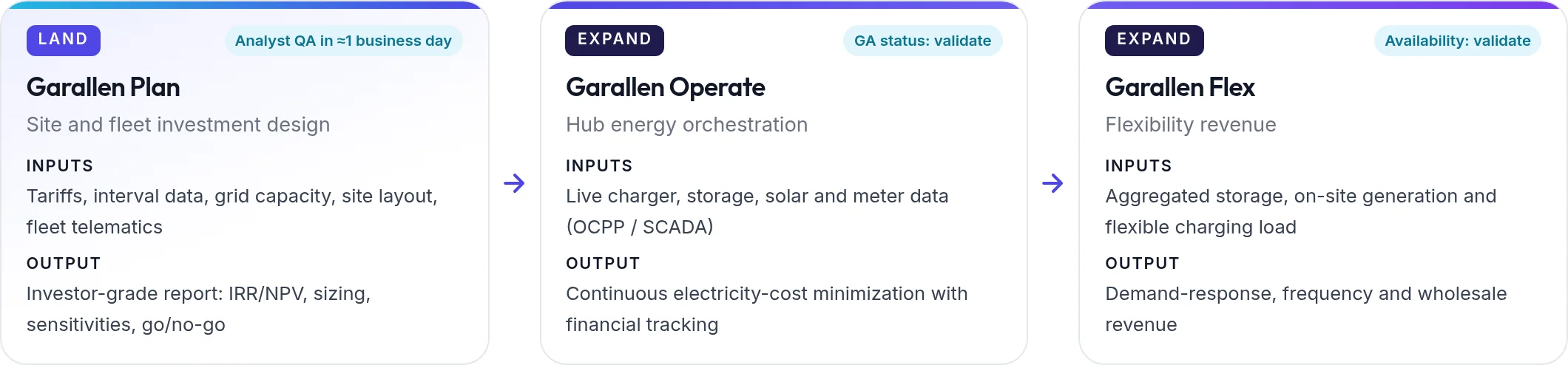
Findings and what they mean for sellers
| # | Topic | Finding | Sales implication | Source | Confidence |
|---|---|---|---|---|---|
| 1.1 | What Garallen Company sells | "The decision platform for EV-integrated charging design, finance and operations": software to plan and run charging sites and depots, greenfield and brownfield. | Sell decisions and outcomes (bankable investment cases, lower capex and energy cost, higher site returns), not "a modelling tool". | S1 | Sourced |
| 1.2 | Module 1 · Garallen Plan | Site and fleet investment design: interconnection feasibility, storage sizing, EV-load modelling, capex/opex, IRR/NPV sensitivities, vehicle TCO, go/no-go. Inputs via Project, Fleet, Hub and Microgrid workspaces; output is an investor-grade report. | The primary land product: every deal starts with a site, fleet or portfolio decision. | S1, S3, S6 | Sourced |
| 1.3 | Module 2 · Garallen Operate | Energy orchestration for charging hubs: real-time monitoring and control balancing EV load, storage, solar and feeder limits; continuous electricity-cost minimization with financial tracking. | Recurring "operate" revenue on built sites; the expand motion after design. | S1 | Sourced GA status: validate |
| 1.4 | Module 3 · Garallen Flex | Aggregates batteries, on-site generation and flexible charging load for demand response, frequency services and wholesale or ancillary revenue. | Late-stage expand; requires market and regulatory qualification per grid operator or utility. | S1 | Sourced No launch found: validate |
| 1.5 | Product naming | The Apr 2026 press release calls the core product "SiteLens"; the website says "Garallen Plan"; 2023–24 materials describe a "charging performance platform" with Design, Build and Run suites. | Standardize naming in decks and CRM. Recommended: Garallen Company Platform → Plan / Operate / Flex; SiteLens = the Plan site workflow. | S1, S11, S14 | Sourced Inconsistent |
| 1.6 | Delivery model | Optimization runs in minutes; a Garallen Company analyst QA-reviews results, usually within one business day, before the report is published. Positions itself as an "embedded project partner, beyond traditional consultancy". | A tech-enabled service: sell speed plus expert QA, and scope analyst capacity in every proposal. | S3, S2 | Sourced |
| 1.7 | Technical credentials | Containerized multi-cloud stack; BI-tool integration; multi-user with admin permissions; APIs for weather, telemetry, tariffs and regulation; deterministic optimization engine for reproducible, auditable results. Standards on request: GDPR, OCPP, OpenADR, lender bankability formats. | Use for IT/security and lender due diligence; respect the "on customer request" qualifiers. | S3, S6 | Sourced |
| 1.8 | Security posture | Multi-tenant with logical access controls; onboarding data anonymized; hosted on two major public clouds; OWASP Top Ten practices; references ISO privacy and IoT guidelines. | Prepare a security questionnaire pack; claim no certification Security has not confirmed. | S8 | Sourced Certifications: validate |
| 1.9 | Value claims (company) | Feasibility scenarios "6–8× faster and at lower cost"; "double-digit improvement in project returns"; on existing sites, "18–24% performance improvement" where sites were never systematically re-evaluated (CEO, Apr 2026). | Approved proof points, but always pair them with a customer-specific model. | S1, S11 | Sourced Vendor claim |
| 1.10 | Segments / ICP | EPCs and engineering firms; fleet owners (logistics, buses, rental and leasing, last-mile); CPOs; real estate owners and managers (REITs, C&I, mixed-use, multifamily, hospitality, self-storage); cities and municipalities; energy developers and financiers. | Six segment plays (Sections 03, 10 and 12). | S1, S4, S5, S6, S13 | Sourced |
| 1.11 | Buyer personas | CFOs and finance leads, fleet managers, charging-hub owners and managers, asset and portfolio managers, capital planning, operations, sustainability and compliance, municipal environmental analysts, EPC proposal teams. | Persona discovery guides in Section 03. | S4, S5, S6 | Sourced |
| 1.12 | Reference customers | An EPC partner engaged Garallen Company for 31 operating sites in CO/UT/AZ (Apr 2026, on behalf of a CPO client); a 24-store convenience-retail EV program with a CPO and the same EPC (2025); earlier pilots with a transit agency, a rental-car franchisee, a retail REIT and a solar developer. | Lead references: EPC/CPO brownfield and retail greenfield. Confirm reference permissions first. | S11, S12, S15 | Sourced |
| 1.13 | Partners | Keystone Ridge Electric (EPC and O&M, "ongoing partnership"); Tidewell Mobility Advisors (consultancy, Jun 2024); Brakeline Fleet Conversions (EV conversion, 2025); a state clean-energy accelerator and a cloud-provider startup program. | The partner-led motion is real and proven: EPCs and consultancies buy or resell analysis for their end clients. | S11, S12, S13, S17 | Sourced |
| 1.14 | Public pricing | Portfolio Screen for real estate: upload up to 15 addresses free (one account per company), no credit card; $45 per additional site; a top-level latent-value estimate per site. No other public pricing. | A product-led entry for property owners; sellers convert ranked portfolios into paid designs. | S4 | Sourced Other pricing: Assumption |
| 1.15 | Sales org signals | CRO Owen Becker; Sales Manager Priya Raman (scheduling link on site); CEO Lena Marchetti active in deals and PR; three industry advisors (Marcus Hale, utilities; Doug Arnett, parcel and logistics fleets; Sana Qureshi, fleet telematics) staff events. About 20–25 employees and two sales staff; the careers page lists only engineering roles. | A small founder-and-CRO team: the playbook must be lean. One AE runs the full cycle; advisors add executive and vertical credibility. | S2, S1, S17, S18, S9 | Sourced Headcount: low |
| 1.16 | Field marketing | GA launch Mar 2024; trade-media webinar Oct 2024; 2025 US roadshow (10 cities); Charge Infrastructure Forum (Phoenix, 2025); PropTech Buildings Expo 2026 (Austin) targeting CPOs, EPCs, REITs and building managers. | An event-driven pipeline cadence; the real estate expo signals a REIT/CRE motion. | S10, S17 | Sourced |
| 1.17 | Thought-leadership framework | "Five disciplines" of charging economics: (1) rigorous upfront financial modelling, (2) data-driven utilization forecasting, (3) grid-aware smart charging, (4) living-plan re-optimization, (5) monetized sustainability (credits, RECs). | Use as the discovery spine and the content for the Value Validation stage. | S7 | Sourced |
| 1.18 | Funding / stage | Founded 2019 by Lena Marchetti and Tomas Reyes. Reported funding varies by source (about $3M to $6M), including state clean-energy grants and a climate-fund seed round. | Position as a specialist, agile partner; expect vendor-viability diligence from enterprise buyers. | S16, S13, S15 | Sourced Figures conflict |
| 1.19 | US policy context | The 30C refueling-property credit is unavailable for property placed in service after Jun 30, 2026; the 45W commercial clean-vehicle credit ended for vehicles acquired after Sep 30, 2025; federal charging-program funds continue through approved state plans, but part of the unobligated balance was transferred to other highway programs. | Thinner subsidies make project economics tighter, so rigorous modelling and brownfield optimization are worth more. Re-model in-flight projects. | S20 | Sourced Confirm with tax advisors |
| 1.20 | Market context | Roughly 80,000 US public charging locations (federal station data, doubled since 2020); an aging installed base with rising failure rates; a site at 15% utilization can reach profitability with a 5-point utilization gain (industry analysis, as cited); markets maturing from expansion to optimization. | Brownfield CPO optimization is a timely wedge. | S11 | Sourced Secondary citations |
| 1.21 | Competitors · fleet planning | Telematics-led EV suitability tools; fleet-electrification planning startups; charging-management platforms with an assessment add-on. | Differentiate on grid and energy co-optimization (storage, solar, microgrid), finance-grade outputs and the design-to-operate lifecycle. | S19 | Sourced |
| 1.22 | Competitors · energy design & ops | Microgrid and DER design software; charging- and energy-management platforms; DERMS and VPP platforms. Incumbents: spreadsheets, engineering consultants and charger vendors' "free" designs. | The biggest competitor is the status quo. As Garallen Company's site puts it, decisions get "delegated to vendors". | S1, S4, GK | Inferred |
| 1.23 | Review sites | No listing or reviews on the major software-review marketplaces. | Build proof through case studies and references; consider a review program. | S18 | Sourced Absence |
| 1.24 | Likely revenue model | Per-site and per-project analysis fees (public $45/site at the screening tier), multi-user platform subscriptions, recurring Operate fees per hub, possible revenue share on Flex. | Price-book placeholders in Sections 07 and 08; validate with RevOps. | S4, S1 | Inferred |
↑ Back to the topSample playbook. Company names and data are illustrative.
Part II
The Sales Process
Eight stages, MEDDPICC-D and the end-to-end motion.
Section 02 · Eight stages, one definition of done
The Sales Process: Stage Overview
Eight stages adapted to a SaaS-plus-expert-QA motion. The classic enterprise "site walk" becomes Site Data Intake & Assessment: a virtual data-room review of tariffs, interval data, grid capacity, telematics and site layout, with a physical visit only when it is warranted.

1Strategic Preparation
- Objective
- Understand the account's sites, fleet or portfolio; EV program status; grid and tariff context; exposure to lost federal credits; and stakeholders. Form a point of view (POV) on where the value is.
- Work products
- Account brief; site/fleet snapshot (public charger locations, depots, properties); a three-hypothesis POV mapped to the five disciplines; persona outreach sequence.
- Exit criteria
- POV in CRM; ≥3 personas mapped; first meeting booked within 14 days.
- Manager actions
- Approve the POV for Tier 1; decide whether the CEO or an advisor should open the door.
- Coaching
- Lead with an insight about their sites (demand-charge exposure, underused locations, a lost 30C credit), not a feature list.
- Assessment questions
- Which sites or projects are most at risk financially? Who owns the investment decision? Is a partner (EPC) already engaged?
- Tools
- CRM (assumed); social-selling tool (assumed); federal station locator; utility tariff databases (GK); 10-K and ESG reports; Garallen Company Insights articles.
2First Meeting / Discovery
- Objective
- Validate pains, quantify impact, map the decision process and data availability; earn the demo.
- Work products
- Discovery notes in MEDDPICC-D format; pain→impact chain; data-availability checklist; agreed next step.
- Exit criteria
- Quantified pain ($ capex, $ energy and demand charges, utilization %, IRR gap, study cost/time); decision process and timeline; data owner named; demo booked.
- Manager actions
- Join Tier 1 calls; grade discovery; check that the finance pain (IRR, capex, opex) is quantified.
- Coaching
- Ask "what happens if this project is built on today's spreadsheet?" Explore all five disciplines; confirm a direct or partner path.
- Assessment questions
- What IRR or payback hurdle applies? What did the last study cost and how long did it take? Who supplies tariff, interval and telematics data?
- Tools
- Discovery guide (Section 03); scheduling link (sourced); five-discipline question bank.
3Demo / Solution Presentation
- Objective
- Show the platform answering their question: a scenario on their site or fleet, a sample investor-grade report and the design-to-operate roadmap.
- Work products
- Tailored demo (Project / Fleet / Hub / Microgrid workspaces); scenario comparison; sample report; Operate/Flex roadmap slide if relevant.
- Exit criteria
- Customer confirms ≥80% of decision criteria addressed; agrees to a pilot or assessment and to share data.
- Manager actions
- Ensure analyst support for technical buyers; rehearse the lender and finance angle for CFOs.
- Coaching
- Demo outcomes (IRR, capex avoided, demand-charge reduction), not screens. Run a sensitivity or what-if live.
- Assessment questions
- Did we show their numbers? Which stakeholder wasn't convinced? Did finance see the investor-grade output?
- Tools
- Demo tenant; sample reports (illustrative); BI dashboard views; launch demo recordings (S10).
4Trial / Pilot
- Objective
- Prove value fast and cheaply: free Portfolio Screen (≤15 sites), paid site assessment, brownfield performance review or a single-hub Operate pilot.
- Work products
- Pilot charter (Section 08); signed success criteria; data received; MAP v1 (Section 09).
- Exit criteria
- Charter signed; results delivered on time (one-business-day QA standard for standard reports); criteria met; agreement to a commercial proposal.
- Manager actions
- Approve scope, price and analyst capacity; refuse open-ended free work beyond the public free tier.
- Coaching
- Tie the pilot to a real decision: which sites to build or upgrade, which fleet phase.
- Assessment questions
- What decision does this pilot unlock? Who signs the follow-on? What is the budget source?
- Tools
- Portfolio Screen upload (S4); Garallen Plan; Operate sandbox (validate).
5Value Validation
- Objective
- Help the buyer adopt a best-practice operating model: the five disciplines, living-plan re-evaluation and monetized sustainability.
- Work products
- Five-discipline maturity readout; reference call (EPC brownfield or retail greenfield); operating model (who maintains the models and how often sites are re-evaluated).
- Exit criteria
- ≥1 reference or peer proof completed; buyer accepts an ongoing (subscription) model.
- Manager actions
- Broker references; bring in the advisor with vertical credibility (utility, logistics, telematics).
- Coaching
- Move the buyer from a one-off study to continuous optimization.
- Assessment questions
- Has the economic buyer heard a peer story? Do they accept re-evaluating sites annually or when tariffs change?
- Tools
- Insights articles (S7); case studies (S11, S12); reference list (validate permissions).
6Site Data Intake & Assessment
- Objective
- Collect and validate the data that drives model accuracy: tariffs, interval and billing data, grid capacity and interconnection status, site layout and rooftop, charger inventory and utilization, fleet telematics and routes.
- Work products
- Completed data-intake checklist; assumptions log; data-gap plan (Garallen Company API defaults vs customer data); optional site-visit notes.
- Exit criteria
- All critical inputs received or defaults approved by the customer; assumptions log signed.
- Manager actions
- Escalate data blockers; confirm analyst capacity and turnaround.
- Coaching
- Accuracy is the product. Document every assumption a lender or CFO will challenge.
- Assessment questions
- Which inputs are defaults and which are measured? Is the utility interconnection status known? Are NDAs needed?
- Tools
- Secure upload; data-room checklist (Section 08); telematics exports; utility bills.
7Pricing / Proposal
- Objective
- Deliver a value-based proposal with options (site pack, portfolio subscription, design plus Operate), an ROI case and terms.
- Work products
- Proposal; ROI business case (Section 07); SOW for analyst QA and deliverables; data and security terms; partner pricing if partner-led.
- Exit criteria
- Proposal presented live to the economic buyer; preferred option chosen; paper process mapped; verbal yes.
- Manager actions
- Deal review (Section 06); approve discounts against guardrails; align partner margin.
- Coaching
- Trade, don't discount: multi-site volume, term length, case-study rights, partner co-marketing.
- Assessment questions
- What does a wrong site decision cost compared with our fee? Who else is being considered (consultant, vendor, competitor)?
- Tools
- Price book (Assumption, validate); ROI model; order form and MSA templates.
8Close
- Objective
- Signed order, a smooth handoff to delivery and customer success, and an expansion plan already seeded.
- Work products
- Signed order form / MSA / DPA; kickoff; workspace set-up; handoff doc; expansion hypothesis (Operate, Flex, more sites).
- Exit criteria
- Booked; kickoff within 5 business days; first deliverable date agreed; case-study or reference consent requested.
- Manager actions
- CEO/CRO thank-you call (Tier 1); win/loss review; case-study ask.
- Coaching
- Close the mutual plan; avoid quarter-end discount pressure; set expansion trigger dates.
- Assessment questions
- Is everything promised in the SOW? When is the first value moment?
- Tools
- CRM; e-signature (assumed); onboarding checklist.
Stage-gate quick checklist
- Stage 1 → 2: POV + ≥3 personas + path (direct or partner) in CRM
- Stage 2 → 3: Quantified pain + decision process + data owner + demo booked
- Stage 3 → 4: Criteria confirmed; customer agrees to share data and run a pilot or assessment
- Stage 4 → 5: Signed pilot charter with a decision date (or a documented skip)
- Stage 5 → 6: Reference or peer proof done; ongoing-model approach accepted
- Stage 6 → 7: Data intake complete; assumptions log signed
- Stage 7 → 8: Proposal presented live; verbal yes; paper process mapped
- Closed: Booked; kickoff ≤5 business days; case-study consent requested
↑ Back to the topSample playbook. Company names and data are illustrative.
Section 03 · Pipeline → qualification → discovery → demo → pilot → partners → executives
The End-to-End Sales Motion
This section turns the stages into daily work: where pipeline comes from, how to qualify it, how to run discovery by persona, how to demo and pilot, how to work with partners and executives, and how to spot a stalled deal before the forecast does.
3.1 Pipeline generation
| Play | What good looks like | Key activities | Owners | Artifacts · Metrics | Red flags |
|---|---|---|---|---|---|
| Product-led: Portfolio Screen | Every free 15-site upload gets a human follow-up within 2 business days with a ranked-portfolio readout. | Monitor uploads; enrich the account; offer a 30-min results walkthrough; propose paid designs for the top sites. | AE / Sales Manager; Analyst | Portfolio Screen form (S4); CRM lead routing (assumed) · Upload→meeting %; upload→paid % | Uploads with no follow-up; free tier abused by vendors |
| Partner-sourced (EPCs, consultancies, integrators) | EPCs and consultancies use Garallen Company in their client proposals and register deals. | Partner enablement; co-selling; per-project partner pricing; joint case studies. | CRO / Partner lead | Deal registration (assumed); partner price list (Assumption) · % pipeline partner-sourced; partner win rate | Partner reselling without registration; channel conflict |
| Events & field marketing | Each event yields booked meetings, not just badge scans. | Pre-book meetings; advisor-staffed booths; 48-hour post-event follow-up; roadshow city meetups. | CRO, AE, Advisors, Marketing | Event calendar (S10, S17) · Meetings per event; pipeline $ per event | No pre-booked meetings |
| Outbound by trigger | Sequences fire on triggers (Section 11): new state awards, CPO acquisitions, depot announcements, REIT ESG commitments, tariff changes. | Trigger monitoring; insight-led emails referencing the five disciplines; CEO and advisor intros. | AE | Social-selling tool; news alerts; Insights articles · Reply rate; meetings booked per week | Generic "demo request" outreach |
| Content & inbound | Insights and white papers convert to meetings. | Gate key assets; webinar series with trade media. | Marketing, AE | Insights library (S7); white paper (S21) · Inbound MQL→SQL % | Content with no CTA |
3.2 Qualification: MEDDPICC-D
| Element | What good looks like | Key activities | Owners | Artifacts · Metrics | Red flags |
|---|---|---|---|---|---|
| M · Metrics | Agreed numeric outcomes: IRR uplift, capex avoided, demand-charge reduction, utilization %, study time and cost saved, tCO2e. | Baseline from customer data; write targets into the pilot charter. | AE + Analyst | ROI model (Section 07) · % opps with documented metrics | "Better insight" without numbers |
| E · Economic Buyer | Met the budget owner: CFO / VP Finance, Head of Fleet, VP Network Development (CPO), Head of Asset Management (REIT), EPC principal, city sustainability director or CFO. | Executive meeting with CEO/CRO; confirm the budget source (opex software, project capex, grant). | AE + CRO/CEO | Exec brief · EB met by Stage 4 | Only an analyst or engineer engaged by Stage 6 |
| D · Decision Criteria | Criteria include accuracy and auditability, bankability (lender acceptance), speed, data security, integration (OCPP, OpenADR, BI), price and vendor viability. | Shape criteria toward bankable, deterministic, design-to-operate. | AE + Solutions | Criteria matrix · % criteria influenced | Lowest price only; "free design from the charger vendor" accepted |
| D · Decision Process | Steps mapped: champion → technical validation → finance review → procurement / IT security → signature (or partner → end-client approval). | Map in the MAP; find the security review early. | AE | MAP (Section 09) · Process documented by Stage 3 | Unknown approvers |
| P · Paper Process | Order form / MSA, DPA (GDPR), security questionnaire, insurance, public procurement rules (cities: RFP or cooperative purchasing), partner subcontract terms. | Send standard docs at Stage 4; pre-fill the security pack. | AE + COO | MSA/DPA templates (validate); security pack (S8) · Days in legal/procurement | Public-sector RFP discovered at proposal |
| I · Identify Pain | Pain tied to money and risk: missed ROI, demand-charge bills, underused or failed sites, grid-upgrade delays, slow or expensive studies, lost federal credits. | Cost-of-inaction calculation; five-discipline diagnostic. | AE | Five disciplines (S7) · Pain quantified in $ | The pain is "curiosity" |
| C · Champion | An internal advocate with access (Director of EV Infrastructure, Fleet Electrification Manager, Asset Manager). | Champion tasks: share data, convene finance, arrange the EB meeting. | AE | Champion test log · Champion tested by Stage 3 | Champion can't get data or the EB |
| C · Competition | Known alternatives: spreadsheets and in-house teams, engineering consultants, charger-vendor designs, telematics-led suitability tools, fleet-planning startups, microgrid design software, charging- and energy-management vendors. | Battlecards; trap-setting questions (grid co-optimization, bankability, brownfield re-evaluation). | AE + CRO | Battlecards (to build) · Win rate by competitor | "No competition" late in the cycle |
| D · Data readiness | Customer can provide required inputs within 2 weeks, or accepts API defaults with documented assumptions. | Data checklist at Stage 2; assign a data owner. | AE + Analyst | Data-intake checklist (Section 08) · Days to complete data | Data owner unknown; NDA delays |
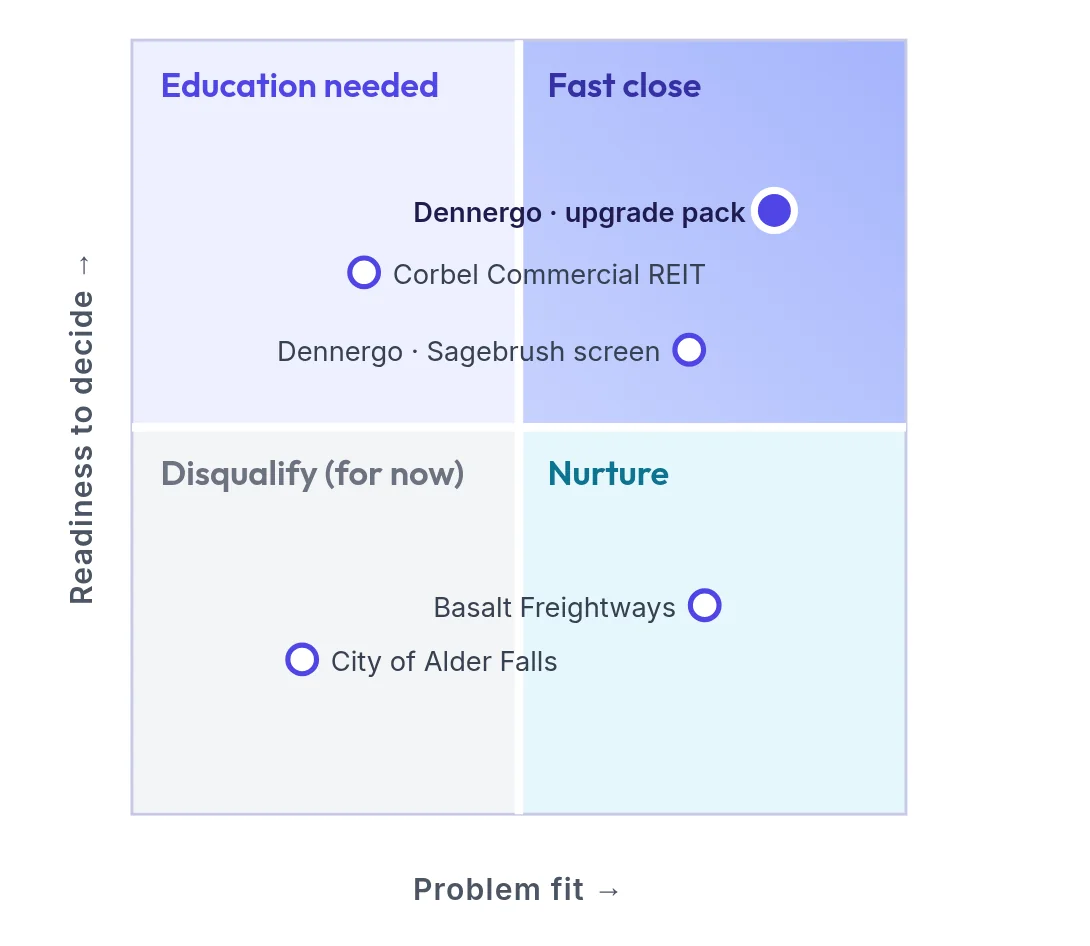
Reading the matrix
- Fast close (strong fit, ready to decide): run the MAP, book the deal review, protect analyst capacity.
- Education needed (ready, fit unproven): lead with the five-discipline diagnostic and a peer story to prove the problem is worth solving.
- Nurture (strong fit, not ready): set a trigger watch (Section 11) and offer the Portfolio Screen or a partner referral. Don't spend analyst time yet.
- Disqualify for now (weak fit, not ready): close-lost with a trigger watch.
3.3 Discovery by persona
| Persona | What they know | Ask about | Owner | Artifact · Metric | Red flag |
|---|---|---|---|---|---|
| CPO · VP Network / Head of Operations | Utilization by site, demand-charge exposure, failures and downtime, expansion vs optimization plans. | Utilization distribution; worst-10 sites; $ demand charges; battery plans; pricing strategy; grid-upgrade queue. | AE | Discovery guide · Discovery score ≥4/5 | No site-level data |
| Fleet · Head of Fleet / Fleet Electrification Manager | Fleet mix, duty cycles, replacement cycle, depot power, TCO targets. | Vehicles by type; routes and dwell; replacement schedule; depot capacity; impact of losing 45W; retrofit or conversion interest. | AE (+ telematics advisor) | Fleet workspace inputs · Vehicles and depots in scope | Pilot EVs bought before an infrastructure plan |
| Real estate · Asset/Portfolio Manager, Capital Planning | NOI uplift, tenant retention, capex discipline, compliance with tenant and regulatory electrification demands. | Properties by type; parking and rooftop availability; NOI targets; tenant EV requests; ESG commitments; existing EV, solar or storage. | AE | Portfolio Screen · Sites uploaded | "Vendors will install for free" mindset |
| EPC / professional services · Principal, Proposal or Engineering Lead | Needs faster, bankable proposals and differentiated bids. | Bids per year; hours per feasibility study; win rate; client financing requirements; O&M offering. | AE / Partner lead | Partner pricing · Projects per year | Sees Garallen Company as a competitor to its consulting |
| CFO / financier / energy developer | Needs IRR/NPV, sensitivities, bankable report acceptance and risk. | Hurdle rate; lender requirements and bankability standard; cost of capital; deal pipeline size. | AE + CEO | Sample investor-grade report · Lender requirements captured | Finance not engaged |
| City / municipality · Sustainability, Transit, Fleet | Needs emissions baselines, funding applications, stakeholder alignment and policy compliance. | Climate targets; grant deadlines; transit and municipal fleet size; public charging plans; procurement route. | AE (+ utility advisor) | Cities workflow (S6) · Grant deadline captured | No procurement path |
3.4 Demo, pilot, partners and executives
| Element | What good looks like | Key activities | Owners | Artifacts · Metrics | Red flags |
|---|---|---|---|---|---|
| Demo | |||||
| Tailored scenario demo | Uses the customer's site or fleet (or a close proxy) and answers their decision question live with what-if scenarios. | Pre-call with the champion; prepare the scenario; show the investor-grade report and sensitivity; close on a pilot. | AE + Analyst | Demo tenant; sample reports · Demo→pilot % | Generic tour; no next step |
| Pilot | |||||
| Pilot with MAP | Charter with success criteria, data plan, decision date and commercial next step. | Charter → data intake → model run → one-day QA → readout → proposal. | AE + Analyst + Champion | Sections 08 & 09 · Pilot→win % | Free, open-ended analysis |
| Partner engagement | |||||
| EPCs & installers (e.g., Keystone Ridge Electric) | Garallen Company embedded in the EPC's feasibility and upgrade offerings. | Partner onboarding; per-project pricing; co-branded reports (validate); joint pursuit of CPO and retail portfolios. | CRO / Partner lead | Partner playbook · Partner projects per quarter | Partner withholds end-client access |
| Consultancies (e.g., Tidewell Mobility Advisors) | Consultants deliver strategy; Garallen Company powers the analytics. | Joint offers (free diagnostic → roadmap); referral and resale terms. | CRO | Referral agreement (assumed) · Referrals per quarter | Overlapping scopes |
| EV conversion, hardware & logistics partners (e.g., Brakeline) | Joint fleet-electrification packages. | Bundle analysis with conversion and charging offers while keeping the modelling vendor-neutral. | CRO, AE | Joint pitch · Joint opportunities | Perceived loss of neutrality |
| CPOs & site hosts as channel | Site host + CPO + EPC + Garallen Company as the design layer (the retail-rollout model). | Map all parties early; agree who pays (EPC, host or CPO). | AE | Stakeholder map · Multi-party deals closed | Unclear payer |
| Executive alignment | |||||
| CEO / CRO / advisor sponsorship | Every Tier 1 deal has an exec sponsor; vertical advisors join key meetings (utilities: Marcus Hale; logistics: Doug Arnett; fleet telematics: Sana Qureshi). | Exec-to-exec call at Stage 2–3 and before the proposal; an advisory-board-style session for strategic accounts. | CEO, CRO, Advisors | Exec brief template · Exec touches per Tier 1 | Executives appear only at escalation |
3.5 Champion test
Real champion
Sells for you when you're not in the room
- Information: shares the pain, the politics, the competition and the hurdles
- Access: introduces you to the EB, finance and IT, and answers by text
- Credibility: has delivered a capital project before; others trust their judgement
- Personal win: their metrics (uptime, NOI, fleet TCO) improve if you win
Coach, not champion
Friendly, but cannot move the deal
- Gatekeeper: everything must go through them; restricts information
- Low credibility: process keeps changing; overpromises; no-shows
- No stake: "loves the demo" with no outcome they own
- Friend zone: "a colleague might be interested"
3.6 Stalled-deal indicators and recovery
Leading indicators · review weekly
Triage any stall within 7 days
- No customer action in 14 days
- Data not delivered within 2 weeks
- EB not met by Stage 5
- Pilot running without a decision date
- "Waiting on grants or policy"
- Partner went silent
- Security review not started 30 days before close
- Champion left the company
- Owners: AE + CRO · Tools: MAP, CRM stage aging · Metric: stage age vs benchmark
Stalled-deal recovery playbook
- Re-quantify the cost of inaction with a fresh scenario (post-30C economics, a new tariff)
- Offer a smaller decision: a 3-site assessment or a single-site upgrade case
- Go exec-to-exec (CEO, CRO or the relevant advisor)
- Unblock data: accept API defaults with documented assumptions
- No movement in 30 days: downgrade the forecast and nurture with trigger alerts
Stall signal → likely cause → first move
| Signal | Most likely cause | First recovery move | Owner · within |
|---|---|---|---|
| No customer action in 14 days | The decision question was never agreed; the deal is "interesting", not urgent | Re-send the one-page decision question with a cost-of-delay number; ask the champion to confirm or kill it | AE · 2 days |
| Data not delivered within 2 weeks | Data owner unnamed, or IT has not cleared the NDA/DPA | Offer API defaults with documented assumptions; book 30 minutes with the data owner and IT together | AE + Analyst · 3 days |
| EB not met by Stage 5 | Champion lacks access, or is protecting the project | Run the champion test again; propose an exec-to-exec note the champion can forward | AE + CRO · 5 days |
| Pilot running without a decision date | Charter signed without a dated go/no-go | Re-issue the charter with a readout date and the decision it will trigger | AE · 2 days |
| "Waiting on grants or policy" | The business case only works with incentives | Re-model incentive-neutral; show the sites that pencil without credits | Analyst · 5 days |
| Security review not started 30 days out | Paper process not mapped in the MAP | Send the standard security pack pre-filled; name the reviewer in the MAP | AE + COO · 3 days |
| Champion left the company | Single-threaded deal | Re-open with the EB using the readout; identify a new champion from the committee map | AE + CRO · 7 days |
↑ Back to the topSample playbook. Company names and data are illustrative.
Part III
Plan & Prioritize
Territories and a fully worked Tier 1 account plan.
Section 04 · Where to hunt, in what order, with what capacity
Territory Planning
With a small team, territories are best cut by segment and region (for example: Mountain West and California CPO/retail; national REIT/CRE; fleets and logistics; Canada). Targets below are illustrative assumptions. Calibrate them to quota and to capacity, including analyst QA capacity, which is the real constraint on how many pilots can run at once.
| Step | Activity | Data sources | Output | Cadence | Target (illustrative) |
|---|---|---|---|---|---|
| 1 · Research | Build the universe per segment: CPOs (by site count), EPCs and installers, REITs and multi-site owners, fleets of 50+ vehicles, cities and transit agencies, energy developers and financiers. | Federal station data; REIT lists; fleet databases; state funding award lists; trade-show attendee lists; professional networks | Account universe by segment and region | Annual + quarterly | 100% of accounts segmented |
| 2 · Market priority | Prioritize regions with high charger density, aging networks, high demand charges and active incentives (Mountain West and California first, per S11). | Station data; utility tariffs; reliability studies; state programs | Region heat map | Semi-annual | Top-5 regions defined |
| 3 · Whitespace | For each account: sites and depots not yet analyzed; modules not owned (Plan, Operate, Flex). | CRM; customer workspaces | Whitespace matrix | Quarterly | Whitespace ≥4× quota |
| 4 · Tiering | Apply the Section 10 model. | Steps 1–3 | Tier list | Annual + on trigger | Tier 1 ≤10 accounts per AE |
| 5 · Partner map | Assign EPCs, consultancies and hardware partners by region and segment. | Partner list | Partner coverage map | Semi-annual | ≥2 active partners in each top region |
| 6 · Activity plan | Weekly activity standards. | CRM | Activity targets | Weekly | See activity standard below |
| 7 · Pipeline math | Quota ÷ win rate ÷ ACV; cycle length by segment (partner per-project 2–6 wks; CPO/REIT portfolio 1–4 mo; fleet/city 3–9 mo, Assumption). | CRM history | Pipeline target | Quarterly | Coverage ≥3× |
| 8 · Capacity check | Match booked pilots and projects to analyst QA capacity (one-business-day standard). | Delivery calendar | Capacity plan | Bi-weekly | No pilot starts without a capacity slot |
| 9 · Review | Territory QBR. | All of the above | QBR deck | Quarterly | Plan vs actual; mix of projects, subscriptions and Operate |
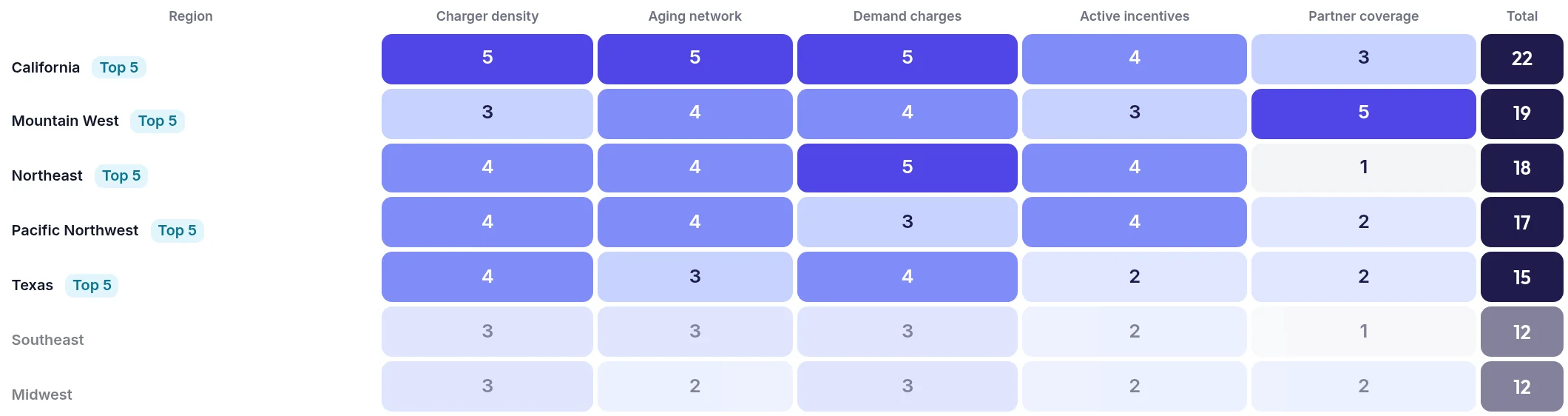
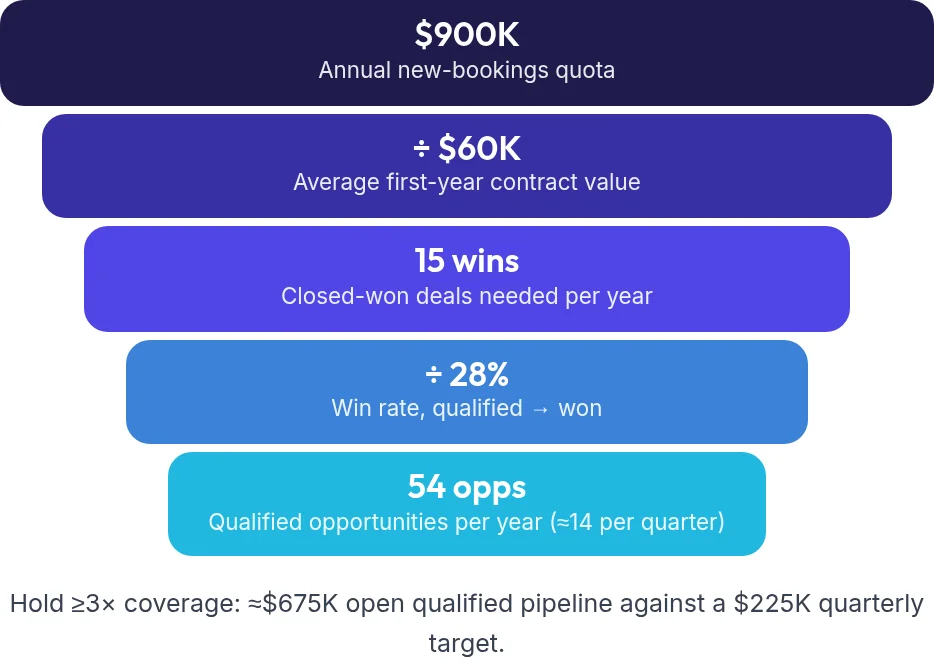
Territory plan deliverables
- Segment universe and tiers
- Region heat map
- Top-25 focus list with live triggers
- Partner coverage map
- Pipeline math and capacity plan
↑ Back to the topSample playbook. Company names and data are illustrative.
Section 05 · The template, filled in for a live Tier 1 account
Account Plan: Dennergo
Required for Tier 1 (all sections) and Tier 2 (sections A–F). Keep it to two pages and update it in the CRM. The right-hand example column is the live plan for Dennergo; use it as the standard for depth.
DennergoTier 1 · Score 87 · Motion C
- Segment
- Regional charge point operator (CPO)
- HQ
- Salt Lake City, UT · ~210 employees · founded 2017
- Footprint
- 132 DC fast-charging sites (586 ports, 150–350 kW) in UT, CO, AZ, NV, NM + 40 Level 2 destination sites
- Ownership
- Backed by an infrastructure fund (Ridgeline Infrastructure Partners); board approves capex over $250K
- Budget cycle
- Calendar FY; FY27 budget locks mid-December; monthly capex committee
- Live triggers
- Acquired the 22-site Sagebrush Fastcharge network (Aug 2026) · 14 planned builds lost 30C eligibility · new CFO (Jul 2026) · utility rate case filed (Sep 2026)
| Section | Field | What to capture | Dennergo example (illustrative) | Owner | Update |
|---|---|---|---|---|---|
| A. Account overview | Profile | Segment, HQ, regions, number of sites / depots / properties, EV program stage, budget cycle. | Regional CPO: 132 DCFC sites in 5 Mountain West states (+22 acquired); FY = calendar year; budget locks mid-December. | AE | Annual |
| Strategic priorities | Growth vs optimization; ESG targets; funding dependencies. | Shift from expansion to optimizing aging sites; integrate the Sagebrush network; 14 2H-2026 builds lost 30C eligibility. | AE | Annual | |
| B. Asset footprint | Sites / fleet / portfolio | Count, types, chargers (kW), utilization, storage/solar, grid constraints; fleet by vehicle type. | Network utilization 11%; 41 sites under 8%; 17 sites where demand charges exceed 40% of the energy bill; 9 sites reach end of hardware warranty in 2027. | AE + Analyst | Semi-annual |
| Garallen Company coverage | Sites analyzed, modules used, workspaces and users, Operate-connected hubs. | 31 sites analyzed with Plan (via Keystone Ridge Electric, Apr 2026); 0 on Operate; 2 users. | CS / AE | Quarterly | |
| C. Relationship map | Buying committee | EB, champion, technical, finance, procurement/IT, blockers; sentiment. | VP Network Development Daniel Okafor (EB); Director Site Operations Rachel Lindqvist (champion); CFO Martin Shaw (approver). See Figure 5.1. | AE | Monthly |
| Ecosystem | EPCs, site hosts, utilities, financiers, hardware vendors. | EPC partner: Keystone Ridge Electric; utility: a Mountain West investor-owned utility; fund owner and an infrastructure lender. | AE | Quarterly | |
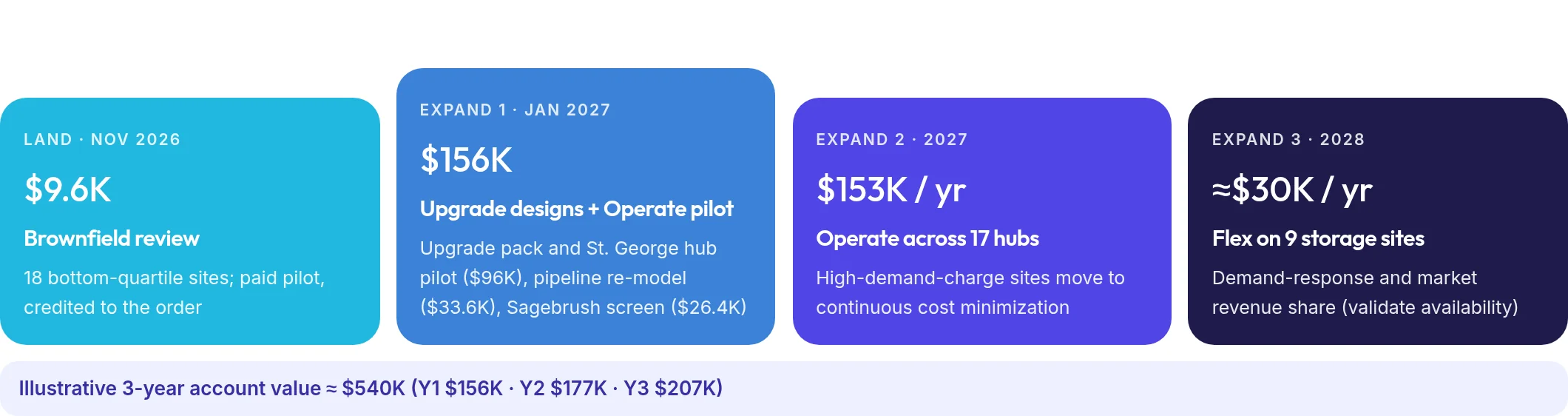
| D. Opportunity map | Active & planned | Opportunity, module, sites, $, stage, close date, path (direct or partner). | Upgrade design pack + Operate pilot, 18 sites, $96.0K (Stage 4, Jan 29); pipeline re-model, 14 sites, $33.6K (Stage 3, Dec 18); Sagebrush screen, 22 sites, $26.4K (Stage 2, Dec 18). | AE | Weekly |
| Whitespace | Remaining sites, new regions, Operate/Flex, more users and teams. | 123 sites not yet analyzed (incl. 22 acquired); Operate on 17 high-demand-charge sites; Flex eligibility on 9 sites with planned storage (validate). | AE | Quarterly | |
| E. Value hypotheses | Top 3, quantified | Quantified (Section 07). | H1 +6% revenue on 18 bottom-quartile sites ($227K/yr; conservative vs the 18–24% vendor claim). H2 −15% demand charges ($140K/yr). H3 $330K capex avoided by redesigning 2 of 14 pipeline builds. | AE + Analyst | Quarterly |
| F. Competitive position | Alternatives | Incumbent tools, consultants, vendor designs; competitors. | In-house spreadsheet model + a regional engineering firm (~$8K and 6–8 weeks per study); evaluating a charging-management platform's assessment add-on. | AE | Quarterly |
| G. Strategy | Land / expand motion | Pick from Section 12. | Motion C: brownfield review → upgrade designs → Operate → Flex. | AE + CRO | Quarterly |
| Exec alignment | Exec sponsor and advisor; meeting plan. | CEO Lena Marchetti ↔ CEO Teresa Valdez; CRO Owen Becker ↔ CFO Martin Shaw; advisor Marcus Hale on interconnection strategy. | CRO | Semi-annual | |
| H. 90-day actions | Action / owner / date | Concrete next steps. | 31-site readout (Oct 30); CEO-to-CEO call (Nov 10); MAP kickoff (Nov 19); Operate pilot charter (Dec 4). Full list below. | AE | Bi-weekly |
| I. Risks & asks | Risks; resource needs | Analyst capacity, data access, policy shifts, vendor-viability concerns. | Need 2 analyst-weeks Nov–Dec; security questionnaire; Sagebrush interval data missing on 9 sites; possible fund-level capex freeze until the Q1 board. | AE | Monthly |
| J. KPIs | Account KPIs | ARR/bookings, sites analyzed, modules adopted, realized savings, NPS, reference status. | Sites analyzed 31 → 71 (Q1 2027) → 154 (Q4 2027); first Operate hub live Apr 2027; reference-ready by Q3 2027. | AE / CS | Quarterly |
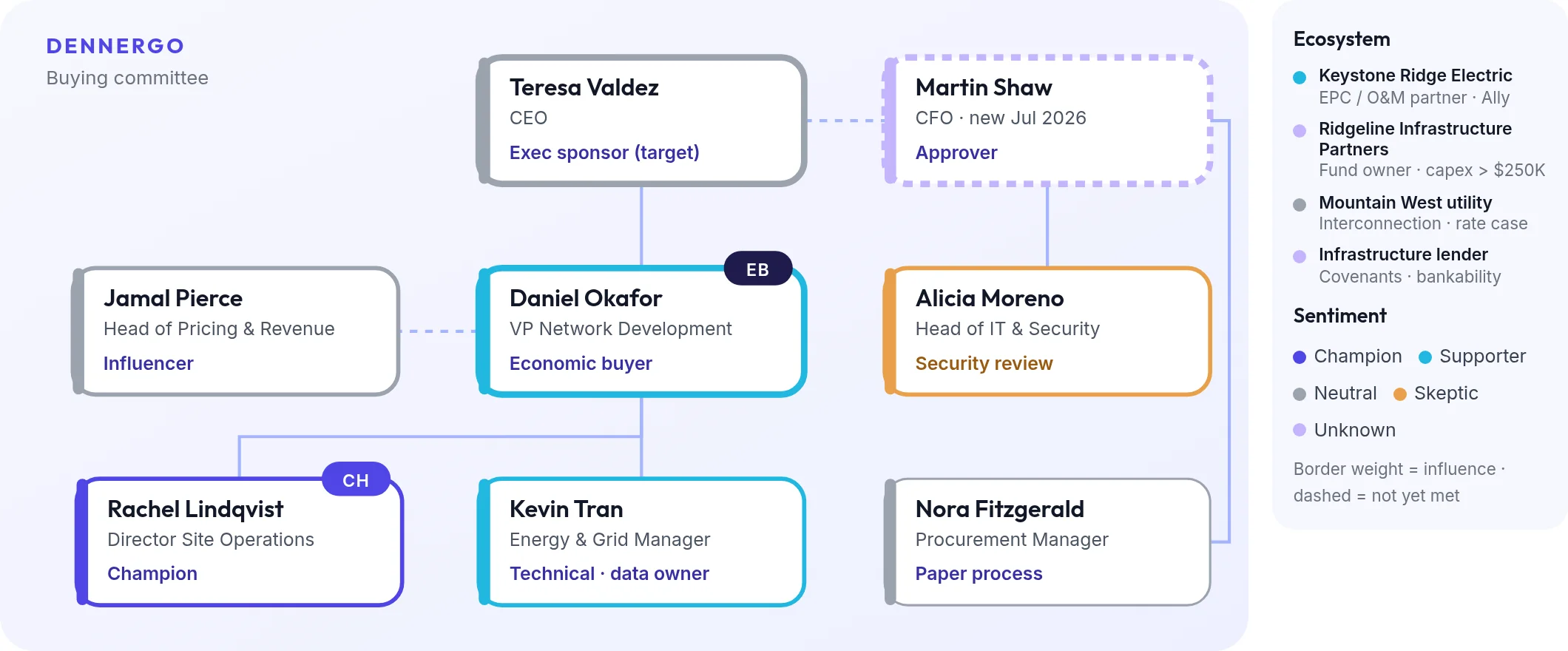
| Stakeholder | Role in decision | Sentiment | Influence | What they need to hear · our next move |
|---|---|---|---|---|
| Teresa Valdez, CEO | Executive sponsor (target) | Neutral | High | Integration of Sagebrush without new capex risk. CEO-to-CEO call Nov 10 with a one-page POV. |
| Martin Shaw, CFO (new, Jul 2026) | Approver; owns hurdle rate | Unknown | High | Board-ready IRR on the 14 pipeline builds after losing 30C. CRO intro via champion; send a sample investor-grade report. |
| Daniel Okafor, VP Network Development | Economic buyer | Supporter | High | Which sites to upgrade, which to sell or retire. Readout Oct 30; confirm budget source (opex vs project capex). |
| Rachel Lindqvist, Director Site Operations | Champion | Champion | Med-High | Fewer failing sites and demand-charge surprises. Champion test passed 4/4 (Oct 9). |
| Kevin Tran, Energy & Grid Manager | Technical evaluator; data owner | Supporter | Medium | Auditable tariff and storage models. Owns interval data; data request Nov 6. |
| Jamal Pierce, Head of Pricing & Revenue | Influencer | Neutral | Medium | Pricing scenarios per site. Include pricing what-ifs in the demo. |
| Alicia Moreno, Head of IT & Security | Security review; potential blocker | Skeptic | Medium | Data handling, access control, certifications. Send security pack Dec 1; no unconfirmed claims. |
| Nora Fitzgerald, Procurement Manager | Paper process | Neutral | Low-Med | Standard MSA/DPA and vendor onboarding. Send templates at Stage 4. |
| Sam Delgado, PM, Keystone Ridge Electric | Partner (EPC/O&M) | Supporter | Medium | Upgrade work for his crews. Agree who contracts and partner margin by Nov 19. |
90-day action plan
| Date | Action | Owner | Status |
|---|---|---|---|
| Oct 30 | Readout of the 31-site analysis to Okafor and Lindqvist; agree the 18-site upgrade scope | AE + Analyst lead | Scheduled |
| Nov 6 | Data request: 18 upgrade sites + 22 Sagebrush sites (tariffs, 12 months of interval data, sessions) | AE; Tran (customer) | Planned |
| Nov 10 | CEO-to-CEO call: integration POV and post-30C pipeline risk | Marchetti ↔ Valdez | Planned |
| Nov 19 | MAP kickoff; partner roles and margin agreed with Keystone Ridge | AE; Lindqvist; Delgado | Planned |
| Dec 1 | Security pack and standard MSA/DPA sent | COO; Moreno; Fitzgerald | Planned |
| Dec 4 | Operate pilot charter signed for the St. George hub | AE; Lindqvist | Planned |
| Dec 18 | Pipeline re-model and Sagebrush screen delivered; CFO preview | Analyst lead; Shaw | Planned |
| Jan 12 | Readout with EB and CFO; proposal options presented | AE + CEO | Planned |
Account plan quality check
- Asset footprint quantified
- EB identified and met
- ≥3 quantified hypotheses
- Whitespace sized
- 90-day plan with owners
- Exec sponsor and advisor named (Tier 1)
↑ Back to the topSample playbook. Company names and data are illustrative.
Part IV
Win the Deal
Deal review, business case, pilots and the mutual action plan.
Section 06 · Twenty minutes that decide the forecast
Opportunity & Deal Review
Run a review for every opportunity of $25K or more in first-year value (illustrative threshold), every Tier 1 deal, and before anything moves to Commit. Twenty minutes: the AE presents, the CRO challenges, the analyst lead joins for scope and capacity.

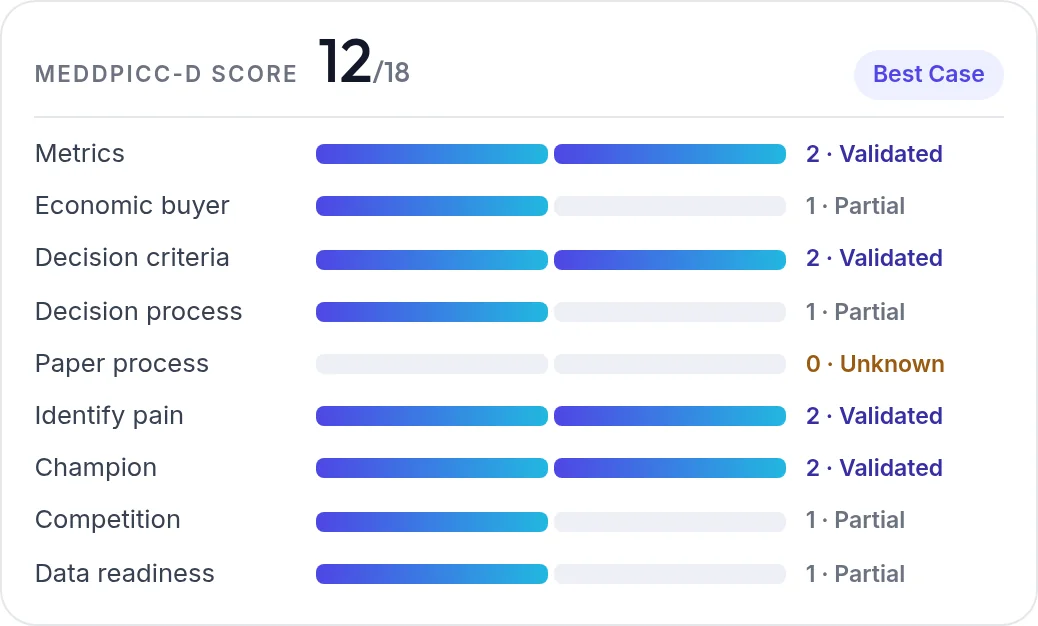
| Review area | Question | Evidence required | Red flag | Next-action owner |
|---|---|---|---|---|
| Metrics | What numeric outcome did the customer agree to? | Pilot charter or email with baseline and target | "Insight" with no number | AE + Analyst |
| Economic Buyer | Who signs, and have we met them? | Meeting notes; budget source | Only analyst-level contact | AE + CRO/CEO |
| Decision Criteria | Top 5 criteria, and our rank against the alternatives? | Criteria matrix validated by the champion | Price-only; benchmark is a free vendor design | AE |
| Decision Process | Steps and dates to signature (including partner or end client)? | MAP with customer dates | Unknown approvers | AE |
| Paper Process | MSA / DPA / security questionnaire / procurement route? | Docs sent; reviewer named | Public RFP surprise; security not started | AE + COO |
| Identify Pain | What does inaction cost? | Quantified $ (capex, opex, IRR gap) | Pain not owned by the EB | AE |
| Champion | What has the champion done for us? | Champion action log | Champion lacks access | AE |
| Competition | Alternatives, including spreadsheets, consultants and vendor designs? | Competitive notes | "No competition" | AE |
| Data Readiness | Is data in hand, or are defaults approved? | Data checklist status | Data more than 2 weeks late | AE + Analyst |
| Scope & Capacity | Is the SOW clear and analyst capacity booked? | SOW; delivery calendar | Custom work not priced | Analyst lead / COO |
| Product Fit | Does the deal need Operate/Flex capabilities or integrations that are not GA? | Product sign-off | Roadmap selling | CRO + R&D lead |
| Partner Dynamics | If partner-led: who pays, who owns the end client, what margin? | Partner agreement / registration | Unclear payer; channel conflict | CRO |
| Commercials | Discount against guardrails; what did we get in trade (term, sites, case study)? | Pricing approval | Unilateral discount | CRO |
| Forecast | Are category and date justified? | Score; MAP progress | Close date slipped twice or more | CRO |
Dennergo review · Oct 21, 2026
Top 3 risks and mitigations
- CFO not engaged (E=1): CRO-to-CFO intro via Lindqvist; send sample investor-grade report. Owner: Becker · Nov 13
- Security not started (P=0): send the security pack and MSA/DPA early. Owner: COO · Dec 1
- Sagebrush data gaps (D=1): approve API defaults for 9 sites, documented in the assumptions log. Owner: Analyst lead · Nov 20
Deal review outputs
- Updated MEDDPICC-D score
- Top 3 risks with mitigation owner and date
- Forecast category
- Resource asks (executive, analyst, legal)
- Next review date
↑ Back to the topSample playbook. Company names and data are illustrative.
Section 07 · Two business cases, one story
Business Case, ROI & TCO
Two business cases matter: the customer's project case (IRR, NPV and TCO of the site or fleet), which Garallen Company produces, and the case for buying it: better, faster decisions versus the fee. Sellers own the second and use the first as proof.
| Value lever | Metric | Calculation / method | Typical inputs | Garallen Company proof point / capability | Source · confidence |
|---|---|---|---|---|---|
| Study speed & cost | Weeks saved; $ consultant cost avoided | (Hours per study × loaded rate, or consultant fee) − Garallen Company fee; cycle time before and after | Studies per year; current cost per study | Scenarios "6–8× faster and at lower cost"; results in minutes + QA in about one business day | S1, S3 · vendor claim |
| Capex avoided (right-sizing) | $ capex | Overbuilt chargers, storage or grid upgrades avoided vs the baseline design | Baseline design; equipment quotes | Interconnection feasibility, storage and hub sizing; "avoid overbuilding and misplaced capex" | S1, S4 |
| Site-selection quality | Portfolio NPV; sites rejected | Σ NPV of selected sites vs naive selection; losses avoided on rejected sites | Candidate sites, traffic, competition | Portfolio Screen; the 24-store retail program evaluation | S4, S12 |
| Utilization / revenue | Revenue uplift % | Δ sessions × price; optimal pricing scenarios | Session data; pricing | Utilization forecasting; pricing optimization; 18–24% on re-evaluated sites (company claim) | S5, S7, S11 |
| Energy & demand charges | $ opex reduction | Demand-charge reduction from smart charging, storage, solar; time-of-use shifting | Interval data; tariffs | Plan tariff/storage/solar modelling; Operate continuous cost minimization | S1, S7 |
| Grid-upgrade timing | Months saved; $ upgrade avoided | Compare grid upgrade vs microgrid vs managed-charging scenarios | Utility capacity; quotes | "Integrate with the grid, request an upgrade, or build an EV-integrated grid" decision | S5, S6 |
| Fleet TCO | $/mile; TCO delta ICE vs EV | Vehicle + energy + maintenance + infrastructure over the horizon | Fleet data; duty cycles | Fleet workspace: optimal fleet size, schedule, vehicle TCO | S3, S5 |
| Financing / bankability | Time to financial close; cost of capital | Faster lender approval; lower risk premium (qualitative unless the lender confirms) | Lender requirements | Investor-grade report; bankability formats on request; deterministic, auditable engine | S3 |
| Flexibility revenue | $ per kW-yr | Demand-response, ancillary and wholesale revenue from aggregated storage and EV load | Grid operator / utility program rules | Garallen Flex | S1 · validate availability |
| Sustainability monetization | $ credits; tCO2e | Carbon credits, RECs and clean-fuel-standard credits embedded in the model | Energy mix; program rules | "Monetized sustainability" discipline; automated carbon calculations | S7, S14, GK |
| Risk reduction | Downside IRR (P90) | Sensitivity on tariffs, utilization, interest rates, incentives | Assumption ranges | Scenario-comparison engine; sensitivity analysis | S3, S14 |
| Ongoing re-optimization | Annual value of a model refresh | Value of decisions after tariff, policy or hardware changes, without new consulting | Change events per year | "Living plan" re-optimization; continuously updated data | S7, S5 |
Worked example: Dennergo, 18 bottom-quartile DCFC sites
Illustrative. Replace with the customer's data; the Garallen Company fee is a placeholder until the price book is confirmed.
| # | Assumption / input | Value | Note |
|---|---|---|---|
| 1 | Sites in scope | 18 operating DCFC sites | Brownfield optimization |
| 2 | Avg charging revenue per site | $210,000 / yr | Customer data |
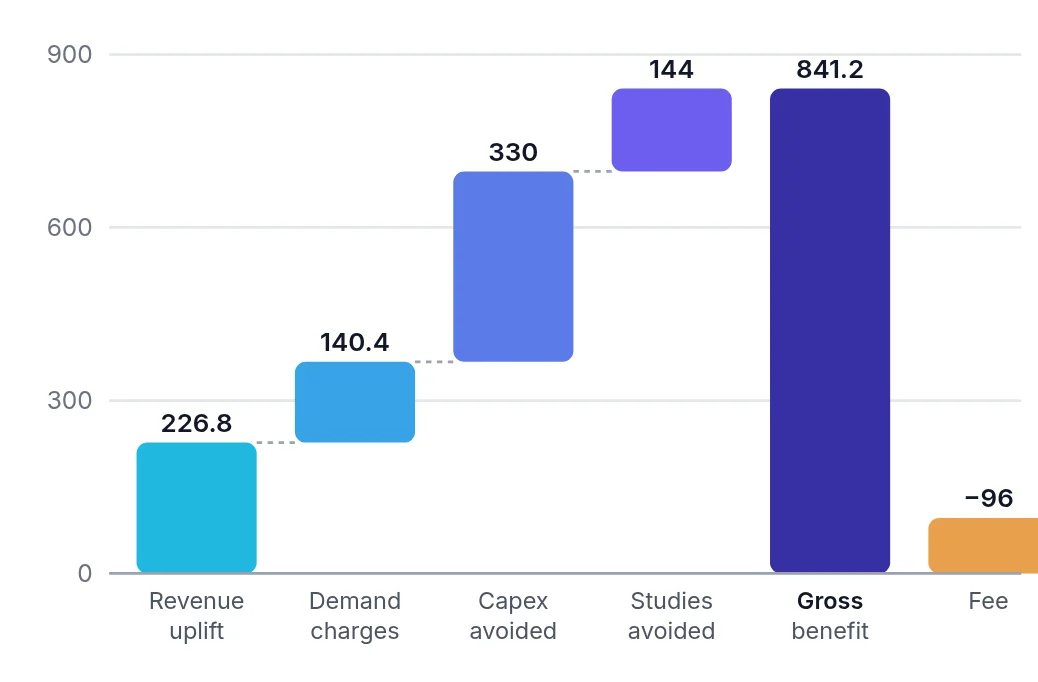
| 3 | Revenue uplift (re-sizing, pricing, ops) | 6% → $226,800 / yr | Conservative vs the 18–24% claim |
| 4 | Avg demand charges per site | $52,000 / yr | From bills and interval data |
| 5 | Demand-charge reduction | 15% → $140,400 / yr | Validate per tariff |
| 6 | Capex avoided | 2 builds × $165,000 = $330,000 | One-time; redesigned pipeline sites |
| 7 | Consultant studies avoided | 18 × $8,000 = $144,000 | One-time; plus 6–8 weeks saved |
| 8 | Year-1 gross benefit | $841,200 | 3 + 5 + 6 + 7 |
| 9 | Recurring annual benefit | $367,200 / yr | 3 + 5 |
| 10 | Garallen Company fee (placeholder) | $96,000 year 1 | Validate with the price book |
| 11 | Year-1 ROI | ≈ 7.8× | (8 − 10) ÷ 10 |
| 12 | Not monetized | Financing speed, Flex revenue, carbon credits | Add if the customer can quantify |

Sensitivity: always show the downside
| Case | Revenue uplift | Demand-charge cut | Capex avoided | Studies avoided | Year-1 gross | Year-1 ROI |
|---|---|---|---|---|---|---|
| Downside (P90) | 3% · $113,400 | 8% · $74,880 | 1 build · $165,000 | $144,000 | $497,280 | 4.2× |
| Base | 6% · $226,800 | 15% · $140,400 | 2 builds · $330,000 | $144,000 | $841,200 | 7.8× |
| Upside | 10% · $378,000 | 22% · $205,920 | 3 builds · $495,000 | $144,000 | $1,222,920 | 11.7× |
Business case checklist
- Use customer data where possible; label every default
- Customer validated rates, utilization and hurdle rate
- Incentive assumptions reflect current law (30C / 45W / federal program status)
- Show the downside (sensitivity) case
- Separate one-time from recurring benefits
- Champion and finance have acknowledged the case
↑ Back to the topSample playbook. Company names and data are illustrative.
Section 08 · Prove value fast, cheaply and toward a decision
Pilot Setup & Checklists
Default policy: free only within the public Portfolio Screen tier (≤15 sites). Every other pilot is paid, or credited against a follow-on order (policy is an Assumption; validate). Standard deliverable SLA: results QA-reviewed within about one business day of complete data (S3).
| Pilot type | When to use | Scope & duration | Success criteria (examples) | Customer commitments | Garallen Company resources | Exit to commercial |
|---|---|---|---|---|---|---|
| Portfolio Screen (self-serve) | REITs, property owners and multi-site retailers exploring EV, solar or storage | ≤15 addresses; same day to a few days; $45 per additional site | Ranked list with latent-value estimates; ≥3 sites worth deeper design | Upload a spreadsheet; 30-min readout | Automated + AE readout | Paid Plan designs for top sites; portfolio subscription |
| Paid greenfield site assessment | CPO, EPC or retailer deciding where and what to build | 1–5 sites; 1–3 weeks | Investor-grade report per site; go/no-go; IRR/NPV ranges accepted by finance | Site data, tariffs, budget owner at the readout | Analyst QA; AE | Multi-site pack or subscription |
| Brownfield performance review | CPOs with aging or underperforming sites (EPC-partner model) | 10–40 sites; 3–8 weeks | Sites ranked by upside; upgrade designs (chargers, storage, ops); quantified uplift | Utilization and session data, bills, charger inventory | Analyst team; CEO/CRO readout | Upgrade designs + Operate on upgraded sites |
| Fleet transition study | Fleets planning ICE→EV for a depot or region | 1 depot or fleet segment; 2–6 weeks | Optimal fleet mix and schedule; depot charging and grid plan; TCO | Telematics and route data, vehicle list, depot electrical info | Analyst; telematics advisor | Multi-depot rollout; Operate at the depot |
| City / transit planning study | Municipalities needing funding-ready plans | Program level; 4–8 weeks | Emissions baseline and reduction; funding-application-ready financials | Fleet and site data; procurement path | Analyst; utility advisor | Platform access for departments; ongoing reporting |
| EPC partner trial | EPCs and consultants evaluating Garallen Company for bids | 2–3 live bids; 30–60 days | Proposal time down; win rate; client acceptance of the report | Real bids; partner agreement | Partner lead; analyst | Partner subscription or per-project agreement |
| Operate single-hub pilot | A built hub with storage/solar or demand-charge issues | 1 hub; 60–90 days | Electricity cost down vs baseline; uptime; data integration (OCPP / SCADA) | Network / SCADA access; site operator | R&D integration engineer (validate GA status) | Operate subscription across hubs |
| Flex eligibility assessment | Portfolios with storage or flexible load in active markets | Portfolio; 2–4 weeks | Eligible MW; projected $/kW-yr; program pathway | Asset list; interconnection details | Analyst; utility advisor | Flex enrollment (validate availability) |
Pilot charter · Dennergo brownfield performance review
- Decision question
- Which of the 18 bottom-quartile sites should Dennergo upgrade, re-price or retire in FY27, and in what order?
- Scope
- 18 operating DCFC sites (UT, CO, AZ); 4 weeks; Plan brownfield workflow + analyst QA
- Success criteria
- Sites ranked by upside; ≥12 sites with a positive upgrade case at Dennergo's 11% hurdle; modelled uplift within ±10% of actuals on 3 back-tested sites
- Data
- 12 months of tariffs and interval data, sessions, charger inventory; owner: Kevin Tran; due Dec 11
- Decision maker / date
- Daniel Okafor (EB) with Martin Shaw (CFO) · readout Jan 12, 2027
- Commercial next step
- Upgrade design pack + Operate pilot (Section 07 options), signature target Jan 29, 2027
- Price
- $9,600, credited in full against an order signed by Jan 29, 2027
Six pilot success factors
If one is missing, it's a free consulting project
- Skin in the game: paid, or credited, with customer time committed
- Defined, measurable criteria signed before kickoff
- The right players: EB and finance at the readout
- Approvals in place: NDA/DPA and IT access before data moves
- Timeline: kickoff, mid-point and readout dates on the MAP
- Agreed next step if the criteria are met
Pilot setup and data-intake checklist
- Charter signed: decision question, scope, success criteria, decision date, decision maker, commercial next step
- NDA/DPA in place if customer data is sensitive (GDPR and anonymization, S8)
- Data received: tariffs and bills (12 months), interval data, charger inventory and sessions, site layout / parking / rooftop, grid capacity and interconnection status, fleet telematics and routes, financial assumptions (rates, hurdle)
- Assumptions log created; API defaults approved by the customer
- Analyst capacity slot booked; QA SLA communicated
- Mid-point check-in; final readout with the EB and finance
- Readout deck: results vs criteria, $ impact, recommendation, proposal
- Case-study and reference consent requested at the readout
↑ Back to the topSample playbook. Company names and data are illustrative.
Section 09 · One shared plan from kickoff to the 90-day value review
Mutual Action Plan
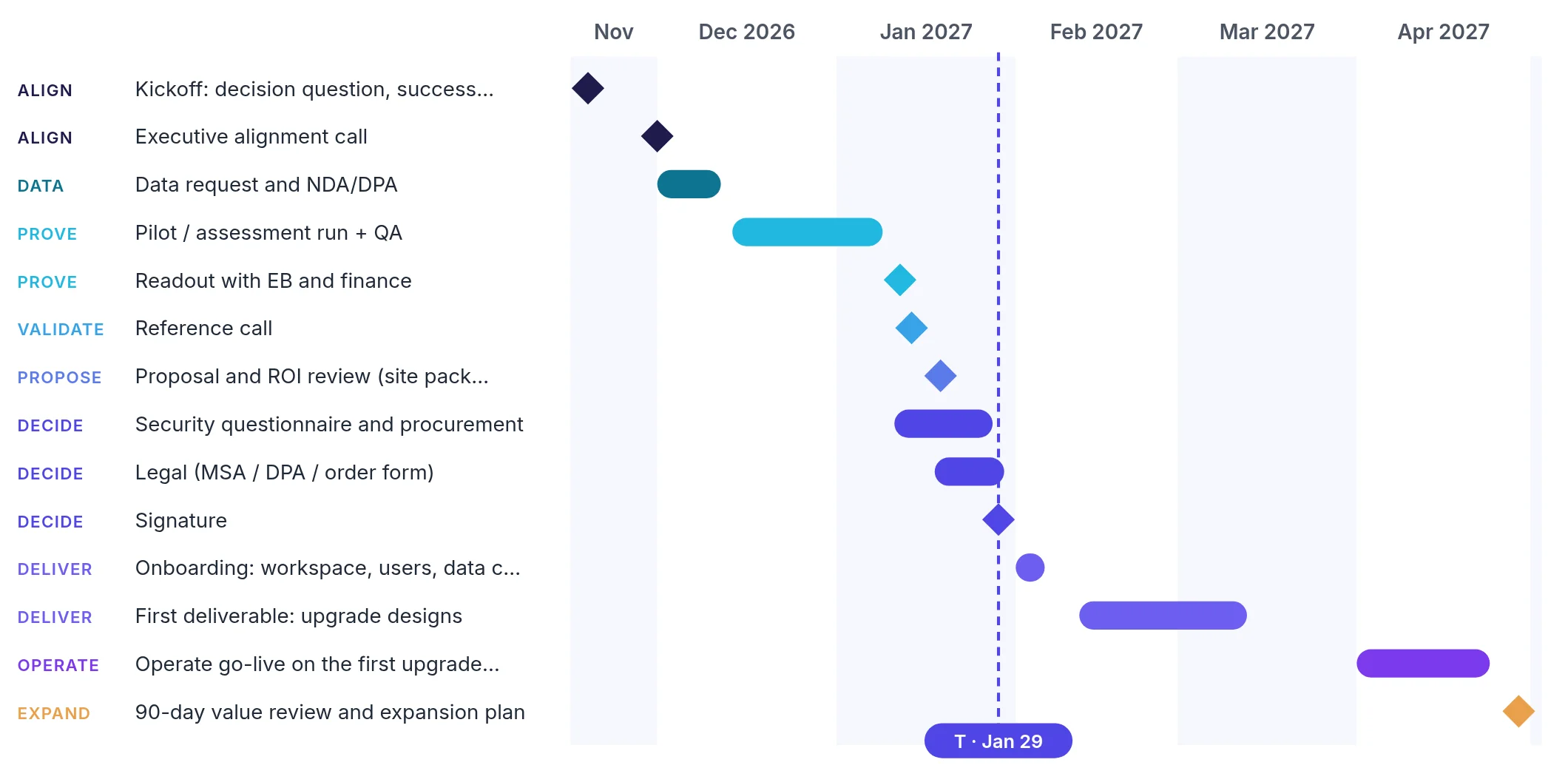
Shared with the customer, and with the partner where relevant. The example is Dennergo's brownfield review → upgrade designs → Operate path. Dates are relative to target signature (T = Fri Jan 29, 2027), with calendar dates for this account. Partner-led deals add an end-client approval milestone.
| Phase | Milestone | Customer owner | Garallen Company owner | Partner owner | Target · date | Exit evidence |
|---|---|---|---|---|---|---|
| Align | Kickoff: decision question, success criteria, timeline | Rachel Lindqvist (champion) | AE | Keystone Ridge PM | T−10 wks · Nov 19 | MAP v1 agreed |
| Align | Executive alignment call | Daniel Okafor (EB) | CEO / CRO | — | T−9 wks · Dec 1 | EB confirms priority and budget |
| Data | Data request and NDA/DPA | Kevin Tran; Legal | AE + Analyst | Keystone Ridge | T−9 → T−7 wks · Dec 1–11 | Data checklist complete |
| Prove | Pilot / assessment run + QA | Champion | Analyst lead | — | T−7 → T−4 wks · Dec 14–Jan 8 | Results delivered |
| Prove | Readout with EB and finance | Okafor, Shaw | AE + Analyst + CEO | Keystone Ridge | T−4 wks · Jan 12 | Agreement on value and next step |
| Validate | Reference call | Okafor | AE | — | T−4 wks · Jan 14 | Reference completed |
| Propose | Proposal and ROI review (site pack / subscription / Operate) | Okafor; Finance | AE | Partner pricing | T−3 wks · Jan 19 | Preferred option chosen |
| Decide | Security questionnaire and procurement | Moreno; Fitzgerald | COO / AE | — | T−3 → T−1 wks · Jan 11–27 | Security approved |
| Decide | Legal (MSA / DPA / order form) | Legal | COO | — | T−2 wks → T · Jan 18–29 | Redlines closed |
| Decide | Signature | Okafor (EB) | AE | — | T · Jan 29 | Signed order |
| Deliver | Onboarding: workspace, users, data connections | Champion | CS / Analyst | Keystone Ridge | T+1 wk · Feb 5 | Users active |
| Deliver | First deliverable: upgrade designs | Champion | Analyst | Keystone Ridge | T+2 → T+6 wks · Feb 12–Mar 12 | Designs accepted |
| Operate | Operate go-live on the first upgraded hub | Site Ops | R&D integration | Keystone Ridge O&M | Per plan · Apr 2027 | Hub live; baseline set |
| Expand | 90-day value review and expansion plan | Okafor | AE / CEO | — | T+90 days · Apr 29 | Value report; next sites and modules |
MAP hygiene rules
- The customer owns ≥50% of milestones
- Data milestones are explicit (the biggest stall risk)
- Every milestone has an owner and a date
- Reviewed weekly; changes logged
- Post-sale value milestones included
↑ Back to the topSample playbook. Company names and data are illustrative.
Part V
Focus & Grow
Tiering, buying triggers and land-and-expand motions.
Section 10 · Spend time where the score says, not where the logo says
Account Tiering
Score = Fit (0–40) + Potential (0–30) + Intent/Triggers (0–20) + Access (0–10). Tier 1 ≥75; Tier 2 55–74; Tier 3 35–54; Tier 4 <35 or self-serve. Weights are illustrative.
Fit · 0–40
Is this our kind of account?
Segment, number of sites or depots, EV program stage, grid and tariff complexity, region priority.
Potential · 0–30
How big can it get?
Sites × modules (Plan, Operate, Flex) whitespace.
Intent · 0–20
Why would they move now?
Active triggers from Section 11.
Access · 0–10
Can we reach the decision?
Champion, EB access, partner relationship.
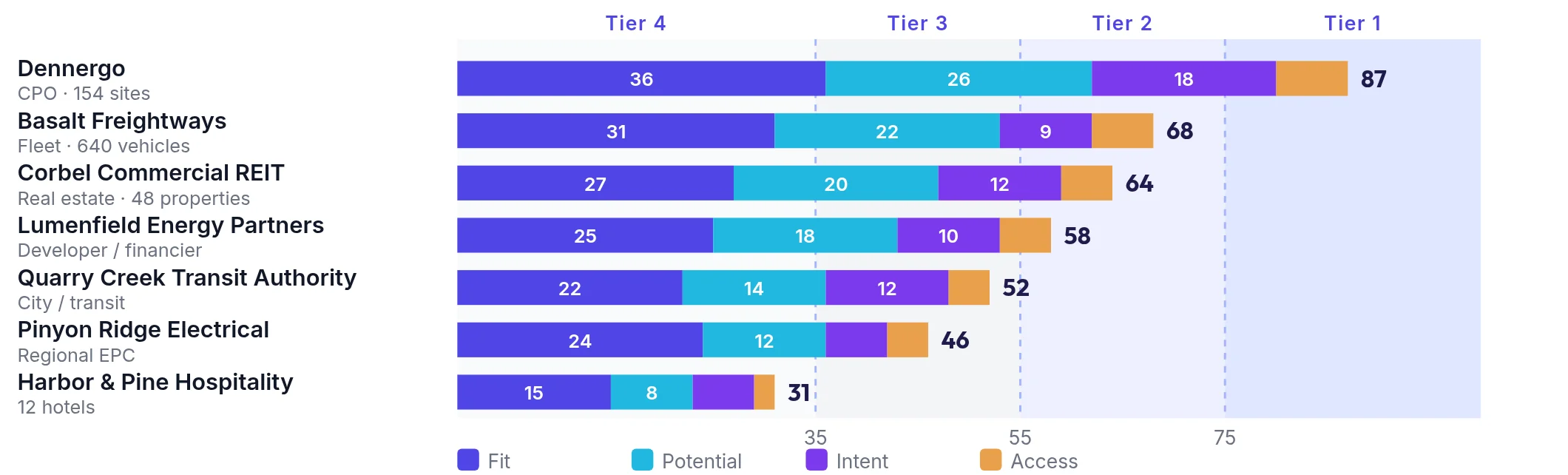
| Tier | Definition / criteria | Example profiles | Coverage model | Engagement cadence | Primary plays | Resource allocation |
|---|---|---|---|---|---|---|
| Tier 1Strategic | Score ≥75; ≥50 sites or depots, or a strategic partner or logo; multi-module potential | Regional or national CPO; national EPC partner; large REIT; national convenience-retail chain; large logistics fleet | AE + CEO/CRO sponsor + analyst lead + advisor | Weekly AE; monthly exec; quarterly business review | Motions A, B, C, D | ~50% of AE time; reserved analyst capacity |
| Tier 2Growth | Score 55–74; 10–50 sites or an active project | Mid-size CPO; regional EPC; multi-site property manager; city or transit agency | AE + pooled analyst | Bi-weekly | Motions A, C, E | ~30% of AE time |
| Tier 3Develop | Score 35–54; early stage or small portfolio | Single-site developer; small fleet; consultancy | AE / inside follow-up; partner-led | Monthly or trigger-based | Portfolio Screen → site assessment; partner referral | ~15% of AE time |
| Tier 4Self-serve / Partner | Score <35 | Small property owners; uploads below threshold | Product-led + partners | Automated nurture | Portfolio Screen; content | ~5% |
Tiering governance
- Re-score annually and on triggers
- Maximum Tier 1 accounts per AE ≈10 (illustrative)
- Tier changes approved by the CRO
- Tier drives exec coverage, MAP requirement and deal-review frequency
↑ Back to the topSample playbook. Company names and data are illustrative.
Section 11 · Twenty signals that make an account worth a call this week
Buying Triggers & Events
Sources: news, social and professional-network alerts, state and federal funding announcements, utility tariff filings, trade shows, Portfolio Screen uploads and partner intel. Urgency: H = act within 1 week; M = within 30 days; L = nurture. Items marked GK should be re-verified.
| Trigger | Category | Signal source | Why it matters | Recommended play | Lead offer | Urgency |
|---|---|---|---|---|---|---|
| Portfolio Screen upload | Product signal | Platform notification | Hand-raiser with portfolio data | Readout within 2 days; propose site designs | Plan site pack | High |
| Underperforming or aging charging network | Operational | CPO disclosures; reliability studies; customer intel | Optimization beats expansion as networks age (S11) | Brownfield performance review | Site performance review | High |
| CPO network acquisition or consolidation | Strategic | Press releases | The new owner must evaluate acquired sites | Portfolio assessment of acquired sites | Brownfield review | High |
| Federal incentive loss (30C after Jun 30, 2026; 45W after Sep 30, 2025) | Policy | Tax guidance (S20) | Pipeline projects need re-modelling | "Re-model your pipeline" campaign | Plan re-evaluation | High |
| Federal or state charging-program round or award | Funding | State DOT plans; federal program reports (S20) | Funded projects need bankable designs fast | Engage awardees and their EPCs | Greenfield assessment | High |
| Utility tariff or demand-charge change | Energy | Utility rate cases | Economics shift; the storage case changes | Tariff-impact scenario | Plan + Operate | Medium |
| Grid-upgrade delay or interconnection queue | Grid | Customer discovery; utility notices | Needs alternatives (storage, microgrid, managed charging) | Grid-alternatives study | Microgrid workspace | High |
| New depot or fleet-electrification announcement | Fleet | Press, RFPs, sustainability reports | Needs a depot design and fleet plan | Fleet transition study | Fleet + Hub workspaces | High |
| Fleet vehicle replacement cycle | Fleet | Fleet data; lease expirations | A natural decision window | TCO comparison | Fleet workspace | Medium |
| REIT / CRE ESG commitment or tenant EV demand | Real estate | ESG reports; real-estate tech expos (S17) | NOI and tenant-retention play | Portfolio Screen | Real-estate offer | Medium |
| EV-ready building codes or parking mandates (state codes, GK) | Regulatory | Code updates | Compliance-driven installs need right-sizing | Code-compliance design | Plan | Medium |
| Retail or convenience chain EV program | Retail | Press; CPO partner news | Multi-site rapid evaluation | Multi-site greenfield pack | Portfolio Screen + Plan | High |
| EPC or installer wins a multi-site contract | Partner | Partner intel; press | The EPC needs fast, bankable designs | Partner trial / per-project | Partner offer | High |
| Storage or solar added at charging sites | Technology | Customer plans; vendor news | Operate / Flex opportunity | Sizing + Operate pilot | Operate | Medium |
| Demand-response or VPP program opening (FERC Order 2222 market rules, GK) | Market | Grid operator / utility announcements | New revenue streams | Flex eligibility assessment | Flex (validate) | Medium |
| Financing event (raise, tax equity, portfolio debt) | Financial | Press; financier intel | Lenders demand bankable models | Investor-grade report for lender diligence | Plan report | High |
| City climate plan or grant deadline | Public sector | Council agendas; grant calendars | Needs funding-ready financials | City planning study | Cities workflow | High |
| New executive (VP Network, Head of Fleet, CFO, Sustainability) | Organizational | Professional networks | New mandates; vendor review | POV meeting within 30 days | Account POV | Medium |
| Trade-show interaction | Marketing | Booth scans; meetings | Warm interest | 48-hour follow-up; demo | Demo / Portfolio Screen | High |
| Charger hardware end-of-life or warranty expiry | Operational | Charger inventory | An upgrade decision is due | Upgrade design case | Brownfield review | Medium |
↑ Back to the topSample playbook. Company names and data are illustrative.
Section 12 · Six motions, each with a land offer and three expand steps
Land & Expand Motions
One row per motion. Write the chosen motion, with dates, into the account plan (Section 05).
| Motion | Land offer | Entry persona | Expand step 1 | Expand step 2 | Expand step 3 | Proof points / KPIs | Risks / watch-outs |
|---|---|---|---|---|---|---|---|
| A. Real estate: Screen → designs → operations | Free Portfolio Screen (≤15 sites) | Asset / Portfolio Manager; Capital Planning | Paid sites beyond 15 ($45/site) + Plan designs for top-ranked sites | Portfolio subscription (multi-user) for capital planning | Operate on built sites; Flex or charging-as-a-service models | Uploads→paid %; sites designed; NOI uplift modelled | Owners delegating to vendors; slow capex decisions |
| B. EPC partner: per-project → platform → embedded offer | Per-project Plan analysis for live bids | EPC Principal; Proposal Lead | Platform subscription with seats for the EPC team | Co-delivered brownfield reviews for the EPC's CPO clients | Operate + O&M bundle with the EPC's maintenance services | Projects per quarter; partner-sourced ARR; bid win rate | EPC sees overlap with its engineering; end-client access |
| C. CPO brownfield: review → upgrades → Operate → Flex | Site performance review (10–40 sites) | VP Network / Head of Ops | Upgrade designs (charger sizing, storage, ops changes) for top sites | Operate across upgraded hubs | Flex aggregation of storage and flexible load | Sites reviewed; % uplift realized vs the 18–24% claim; $ demand charges saved | Data access; capex constraints delaying upgrades |
| D. Fleet: study → depot design → operations → network | Fleet transition study (1 depot or segment) | Head of Fleet; Sustainability; CFO | Depot charging + microgrid design | Operate at the depot (cost minimization, scheduling) | Roll out to more depots and regions; partner bundles | Vehicles planned; depots designed; TCO savings | 45W loss changing economics; vehicle delivery delays |
| E. Cities: plan → platform → reporting | Program-level planning study for grant applications | Sustainability Director; Transit / Fleet lead | Multi-department platform access | Ongoing emissions tracking and progress reporting | Public charging network design and operations | Grants won; emissions tracked; departments onboarded | Procurement cycles; political change |
| F. Developers & financiers: screening → pipeline → portfolio ops | Investor-grade reports for deal screening | Investment Director; Energy Developer | Pipeline subscription (many sites and scenarios) | Lender-standard reporting across the portfolio | Operate / Flex for owned assets | Deals screened; time to close | Lender acceptance of reports |
↑ Back to the topSample playbook. Company names and data are illustrative.
Part VI
Field Kit
Sequences, talk tracks and objection handling.
Section 13 · What to say, in what order, to whom
Field Kit: Sequences & Talk Tracks
The process is only as good as the conversations inside it. This kit gives Garallen Company sellers a way to read an account's urgency, a 30-minute first-call structure, a trigger-led outreach sequence written for Dennergo, persona talk tracks and objection responses. Adapt the words; keep the structure.
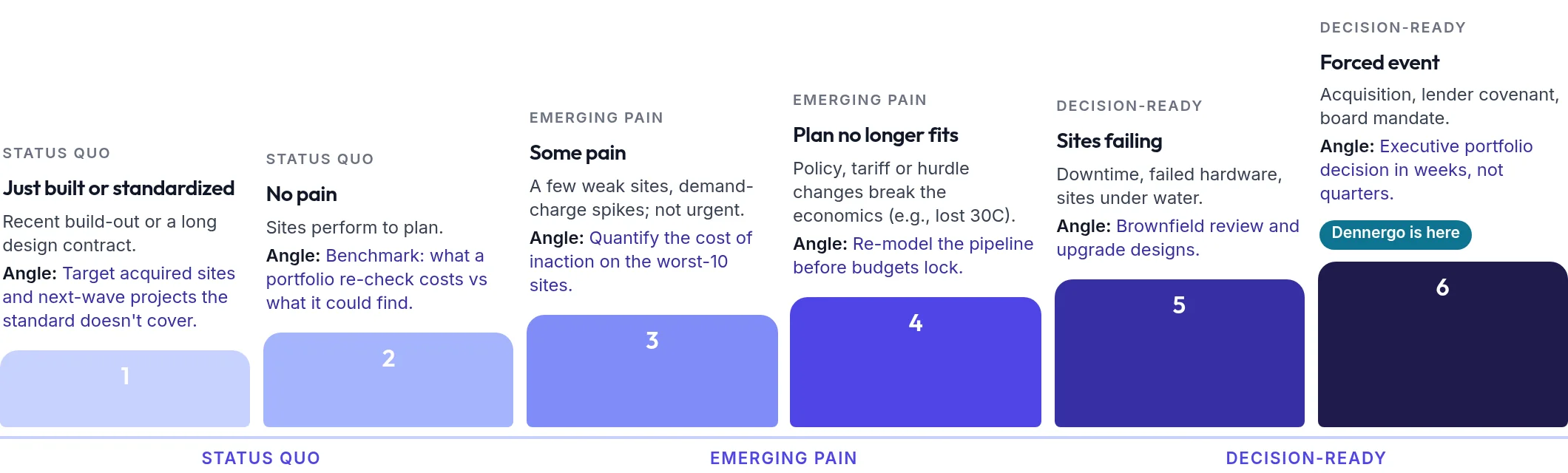
13.1 Read the room: account phase
13.2 Anatomy of a 30-minute first call

Understand
Their sites and their numbers
Utilization spread, demand-charge share of the bill, sites at end of warranty, projects that assumed 30C.
Find
The people
Who owns the investment decision, who owns the data, who has to sign off on security.
Establish
Priority and timing
What is compelling about this quarter? Board meeting, budget lock, acquisition integration, rate case.
Agree
A next step with a date
A readout, a data request, or a working session with finance. Never "I'll send some info".
13.3 Trigger-led sequence: VP Network Development, Dennergo
Trigger: Dennergo's acquisition of the 22-site Sagebrush network plus the loss of 30C eligibility on planned builds. Seven touches over 18 business days across email, phone, social and an executive introduction. Personalize the bracketed fields; never send a touch without a reason to exist.

Day 1 Email22 new sites, 14 re-priced builds
Daniel, congratulations on closing the Sagebrush acquisition. Two things usually land on a network lead's desk right after a deal like that: deciding which acquired sites to upgrade, keep or retire, and re-checking planned builds that assumed the 30C credit. We help CPOs answer both with site-level models their CFO will accept, typically within a business day of getting the data. Worth 20 minutes to compare notes on how you're sequencing the integration?
Day 2 SocialConnect request
Daniel, I follow Dennergo's Mountain West build-out and work with operators on site economics after the federal credit changes. Would be glad to connect.
Day 4 Call + voicemail
Daniel, it's [Name] at Garallen Company. I'm calling about the Sagebrush sites. Most operators we work with find a handful of acquired sites carry most of the demand-charge risk. I have a one-page view on how to find them fast. I'll send it over; my number is [phone].
Day 7 EmailThe 30C math on your 2H builds
Daniel, a quick follow-up with a specific idea. Projects placed in service after June 30 no longer get 30C, so builds approved last year at an 11–12% hurdle can quietly fall under it. A re-model usually changes one of three things: site order, charger count or storage size. Attached is a one-page example (illustrative data) showing what changes. Open to a 20-minute walkthrough?
Day 10 Exec introFrom our CEO
Lena Marchetti (CEO) writes to Teresa Valdez: a short note on Mountain West network integration, one insight from similar operators, and an offer of a 20-minute executive exchange. Copy Daniel.
Day 14 Call
Reference the CEO note. Ask one question: "Of the 22 Sagebrush sites, how many do you already know you'd keep at today's tariffs?" If he engages, book the readout; if not, ask who owns the integration model.
Day 18 EmailClosing the loop
Daniel, I'll stop here so I don't clutter your inbox. If it's useful later, you can upload up to 15 site addresses to our free Portfolio Screen and get a ranked view in a day, no call needed. If integration planning picks up after the budget lock, I'd be glad to help.
13.4 Persona talk tracks
CFO
Defensible returns and fewer capital surprises
"Every site in your plan was approved under assumptions that changed this year. We re-run each one with your hurdle rate, current tariffs and no 30C, and an analyst checks the result before you see it. You get a model your board and lender can audit, not a vendor's estimate."
Ask: What hurdle rate does the board apply, and which projects are closest to it?
Director, Site Operations
Fewer failing sites and demand-charge surprises
"Most networks have a short list of sites that cause most of the pain. We rank every site by upside and tell you what to change, whether that's chargers, storage, pricing or hours, before your crews roll a truck."
Ask: Which five sites would you fix first if budget weren't the question?
Energy & Grid Manager
Models they can trust and defend
"The engine is deterministic: same inputs, same answer, every time, with every assumption logged. Where you don't have interval data yet, we start from documented defaults and you approve them."
Ask: Which inputs do you trust today, and which are guesses?
Head of IT & Security
Low-risk data handling
"We need tariffs, interval data and charger inventory, not customer payment data. Access is role-based, onboarding data can be anonymized, and our security pack answers the standard questionnaire. I'll only claim the certifications our Security lead has confirmed in writing."
Ask: What does your vendor review require, and how long does it usually take?
13.5 Objection handling
| Objection | Response | Then ask |
|---|---|---|
| "Our spreadsheet / engineering firm handles this." | "Keep them. Most of our customers do. We make each study take a day instead of six weeks, so you can re-check every site when a tariff or policy changes instead of once per project." | "When did you last re-run the whole portfolio, and what did it cost?" |
| "The charger vendor designs it for free." | "Their design answers 'which charger'. It doesn't answer 'is this site worth building, and how big should the battery be'. We're vendor-neutral, so the answer isn't tied to a product." | "Who on your team checks the vendor's assumptions today?" |
| "No budget until next fiscal year." | "Understood. A paid review is usually less than one avoided overbuild, and the fee can be credited to a later order. Can we size the decision now so it's in the FY27 plan before budgets lock?" | "What has to be true for this to make the December budget?" |
| "You're a small company. What if you're not around?" | "Fair question. Reports and models are exportable and auditable, so the decision stands on its own. We'll walk your team through our security pack and give you references from operators your size." | "What would you need to see to be comfortable?" |
| "Just send me some information." | "Happy to. So it's useful and not generic: which decision is closest, the acquired sites or the planned builds?" | "Can I send it with 15 minutes on Thursday to walk through it?" |
↑ Back to the topSample playbook. Company names and data are illustrative.
Appendix
Appendix
Adaptation notes and the evidence register.
Appendix A · What was adapted, what was assumed, who validates
Accuracy & Adaptation Notes
This playbook adapts a reference enterprise-playbook structure (originally written for a hardware-plus-cloud field-sales motion) to Garallen Company's SaaS-plus-analyst model. Prepared from public sources as of Oct 16, 2026 for Garallen Company's revenue team; not yet reviewed by Garallen Company leadership. Items marked Assumption or Inferred need validation.
| Item | Reference template element | Garallen Company adaptation | Basis | Validation owner | Open question |
|---|---|---|---|---|---|
| Stage sequence | 8 stages (Prep → Discovery → Demo → Trial → Best Practices → Site Walk → Pricing → Close) | Same sequence; Site Walk = Site Data Intake & Assessment; Best Practices = five-discipline value validation | Adaptation | CRO | Do CRM stages already exist under different names? |
| Demo | Hardware and cloud platform demo | Scenario demo on the customer's site or fleet + sample investor-grade report | Sourced capabilities (S1, S3) | CRO / Product | Is there a standard demo tenant and script? |
| Trial | Free hardware trials | Portfolio Screen free tier (≤15 sites), paid assessments, Operate pilot | Free tier Sourced (S4); paid-pilot policy Assumption | CRO / COO | Official pilot pricing and credit policy |
| Qualification | MEDDPICC | MEDDPICC-D (Data readiness) | Adaptation | CRO | Preferred methodology? |
| Channel | Value-added resellers | EPCs, consultancies, hardware and EV-conversion partners, CPO/site-host consortia | Sourced partners (S11–S13, S17); program terms Assumption | CRO | Formal partner program and margins? |
| Product naming | Hardware product lines | Garallen Plan / Operate / Flex; "SiteLens" (Apr 2026 release) | Sourced, inconsistent | Product / Marketing | Canonical product names and packaging |
| Operate & Flex maturity | — | Positioned as expand modules with "validate GA" flags | On the website; no launch release found | R&D lead / CEO | GA status, reference deployments, supported markets and protocols |
| Pricing | Hardware list prices | Only public: $45 per additional site (Portfolio Screen); all else placeholders | Sourced (S4) / Assumption | CRO / COO | Price book, ACV benchmarks, discount guardrails |
| Thresholds & targets | Field activity metrics | Illustrative ($25K deal review, activity counts, tier scores) | Assumption | CRO | Calibrate to quota and analyst capacity |
| Tools | Internal sales tools | CRM (assumed), social-selling tool (assumed), scheduling link (sourced), e-signature (assumed) | Mostly Assumption | COO / RevOps | Actual CRM and sales stack |
| Security claims | — | Use only S8 statements; ISO references need confirmation | Sourced, unverified | COO | Which certifications are formally held? |
| Funding & headcount | — | Ranges from third-party databases | Sourced, conflicting | CEO / Finance | Approved company facts for sales decks |
| Advisor bio | — | Utility advisor: website says former distribution-planning executive; a professional-network profile lists a different prior role | Sourced, partly inconsistent | CRO | Approved advisor bios |
| Competitors | Hardware competitors | Telematics-led tools, fleet-planning startups, microgrid design software, charging/DERMS/VPP vendors, consultants | Sourced (S19) + GK | CRO | Official battlecards and win/loss data |
| Policy facts | — | 30C / 45W / federal program per S20; state codes, FERC Order 2222 and clean-fuel credits = GK | Mixed | CRO / Advisors | Re-verify before customer use |
| Worked ROI example | — | Illustrative Dennergo case (Section 07) | Assumption | Analyst lead | Replace with an anonymized real customer result |
Open items for Garallen Company leadership
- Canonical product names and packaging (Plan vs SiteLens; Operate and Flex availability)
- Price book, pilot policy and partner terms
- CRM and sales tools in use; stage definitions
- Reference customers and case-study permissions (EPC brownfield, retail rollout, earlier pilots)
- Security certifications and the standard security pack
- Analyst QA capacity model and SLA commitments
- Target regions and segments for FY2027 territories
↑ Back to the topSample playbook. Company names and data are illustrative.
Appendix B · Every [S#] tag, in one place
Evidence Register
In a delivered playbook, every row links to the exact page or document. In this sample the sources are fictional, so links are omitted.
| Tag | Source |
|---|---|
| S1 | Garallen Company homepage: platform, modules (Plan, Operate, Flex), segments, advantages, offices |
| S2 | Garallen Company About page: positioning ("embedded project partner"), leadership and industry advisors |
| S3 | Garallen Plan module page: features, integrations, standards, workflow, one-business-day QA'd report |
| S4 | Garallen Company for Real Estate: Portfolio Screen, pricing ($45 per additional site, 15-site free tier), personas |
| S5 | Garallen Company Applications page: value by persona (finance, fleet, charging hub, property) |
| S6 | Garallen Company sector pages: Logistics and Cities (Project / Fleet / Hub / Microgrid workspaces) |
| S7 | Garallen Company blog: "Why charging projects underperform" (five disciplines), May 2025, + Insights index |
| S8 | Garallen Company Security & Data Privacy page (multi-tenant, anonymization, public-cloud hosting) |
| S9 | Garallen Company Careers page (engineering roles only) |
| S10 | Garallen Company Events: GA launch (Mar 2024), trade-media webinar (Oct 2024), 2025 roadshow (10 US cities) |
| S11 | Press release, Apr 2026: EPC partner selects Garallen Company to re-evaluate 31 charging sites (CO/UT/AZ); "SiteLens" |
| S12 | Press release and trade article, 2025: Garallen Company's role in a 24-store convenience-retail EV rollout |
| S13 | Consultancy partnership announcement, Jun 2024 |
| S14 | Press release, Mar 2024: platform upgrades (sensitivity analysis, carbon calculations) |
| S15 | Startup-ecosystem company profile (earlier pilots; GA Q1 2024) |
| S16 | Funding databases (figures conflict) |
| S17 | Garallen Company professional-network page; expo booth post (Jun 2026); partner and event posts (2025) |
| S18 | Contact-data and professional-network search snippets: headcount ~22, ~2 sales staff |
| S19 | Competitor product pages: telematics suitability, fleet-planning and assessment tools |
| S20 | Federal tax-credit guidance (30C, 45W) and a congressional research report on the federal charging program |
| S21 | Garallen Company white paper (fleet conversion and energy management) |
| GK | General industry knowledge not re-verified in this pass (microgrid tools, VPP vendors, make-ready programs, FERC Order 2222, clean-fuel credits, state codes, MEDDPICC) |
↑ Back to the topSample playbook. Company names and data are illustrative.